
Claude vs DeepSeek: The Perfect Guide for Professionals
February 5, 2026
February 5, 2026
February 6, 2026
February 6, 2026
Generative AI helps professional teams work smarter and faster. They automate routine tasks like drafting documents, analyzing data, and synthesizing meeting notes. Rather than replacing human expertise, they act as intelligent copilots so teams can focus on the work that matters.
At present, we have two great options for professionals seeking efficiency: Claude, developed by Anthropic, and DeepSeek, the Chinese AI company that disrupted the industry with its cost-efficient approach. Understanding how these platforms differ—and where each excels—is crucial for teams making strategic technology decisions.
In this guide, you'll learn:
- The core features and capabilities that distinguish Claude from DeepSeek
- How pricing structures compare across subscription tiers and API usage
- Which platform performs better for specific tasks like coding, math, and creative work
- How to leverage Tactiq to maximize the value of both AI tools through meeting transcription
- Best practices for integrating these AI models into your team's workflow
What is Claude AI?
Claude is a family of large language models developed by Anthropic, an AI safety company founded by former OpenAI researchers. Named after Claude Shannon, the father of information theory, Claude distinguishes itself by focusing on being helpful, harmless, and honest—trained using Anthropic's Constitutional AI approach.
As of late 2025, Claude offers three primary models:
- Claude Opus 4.5 (maximum intelligence for complex reasoning)
- Claude Sonnet 4.5 (the world's best coding model at 77.2% on SWE-bench Verified)
- Claude Haiku 4.5 (near-frontier performance at blazing speed for cost-sensitive applications).
Claude Features and Capabilities
Extended Thinking Mode
Claude's extended thinking capability allows the model to engage in deeper, multi-step reasoning before providing responses. Users can toggle between rapid responses and extended thinking that can span up to 128K–500K token chains. The visible chain-of-thought feature lets users see how the model arrives at conclusions.
Visual Understanding
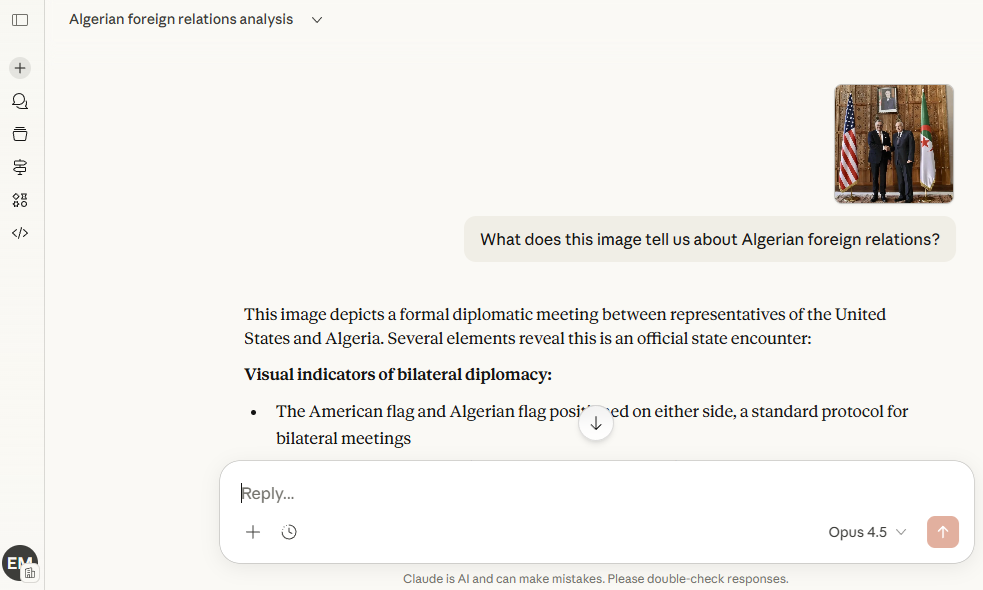
Claude Opus supports both text and image inputs, enabling multimodal analysis. Users can upload documents containing graphs, diagrams, and tables for Claude to interpret and provide insights. This capability makes Claude particularly valuable for analyzing visual content in business documents, presentations, and technical diagrams.
Multilingual Support
Claude handles over 60 languages with strong performance, making it suitable for global teams and multilingual content creation.
Computer Use and Agent Capabilities
Claude introduced computer use capabilities that allow the model to interact with desktop environments—moving cursors, clicking buttons, and typing text. Claude Opus 4.5 scored 61.4% on OSWorld benchmarks for autonomous task execution, dramatically outperforming competitors at 7.8%.
200K–1M Token Context Windows
Claude's massive context windows allow professionals to process entire codebases, lengthy legal documents, or extensive research papers in a single conversation. Claude Sonnet 4.5 uniquely supports up to 1 million tokens via API. This allows for more complex reasoning, improving the coherence and conversationality of the response.
Claude Pricing
Consumer Plans:
- Free: Access to Claude Sonnet with modest usage limits
- Pro ($20/month): Higher usage limits and priority access to advanced models
- Max ($200/month): 20× the usage capacity of Pro, designed for power users
Team and Enterprise: Custom pricing with collaboration tools and centralized billing
API Pricing (per million tokens):
- Opus 4.5: $5 input / $25 output
- Sonnet 4.5: $3 input / $15 output
- Haiku 4.5: $1 input / $5 output
Additional savings available through prompt caching (up to 90%) and batch processing (50% discount).
What is DeepSeek?
DeepSeek is a Chinese AI company founded in July 2023 by Liang Wenfeng, co-founder of the quantitative hedge fund High-Flyer. The company made global headlines in January 2025 when it released DeepSeek-R1, a reasoning model that matched OpenAI's o1 on key benchmarks while reportedly costing only $6 million to train—compared to the hundreds of millions spent by Western competitors.
DeepSeek's models are released under the MIT License, making them truly open-source and available for commercial use, fine-tuning, and self-hosting.
DeepSeek Features and Capabilities
Mixture of Experts (MoE) Architecture
DeepSeek's signature innovation is its MoE architecture, which divides the model into specialized sub-networks (experts). Instead of activating all 671 billion parameters at once, DeepSeek V3 activates only 37 billion parameters per request. When using Claude, processing time can take a while to finish, but DeepSeek’s responsiveness is almost instantaneous due to the much smaller load.
Advanced Reasoning Abilities
DeepSeek-R1 was explicitly designed for advanced reasoning and logical tasks. Through large-scale reinforcement learning focused on reasoning, the model developed emergent capabilities like self-verification and reflection—essentially to check its own conclusions without explicit programming.
DeepSeek-V3.2-Speciale achieved remarkable competition results, including gold medals at IMO 2025 (35/42), IOI 2025 (10th place), and ICPC World Finals (2nd place, 10/12 problems).
Open-Source Nature
DeepSeek models are open-source, with MIT licensing, meaning developers can:
- Fine-tune models for specific use cases
- Own the resulting model weights
- Deploy commercially without restrictions
- Self-host on their own infrastructure
Thinking in Tool-Use
DeepSeek-V3.2 introduced a revolutionary feature that integrates thinking directly into tool use, supporting both thinking and non-thinking modes for agent frameworks.
Cost-Efficient Training
DeepSeek trained V3 for approximately $6 million using around 2,000 H800 GPUs—a fraction of what competitors spent. This efficiency comes from optimized software, FP8 mixed precision training, and the MoE architecture.
DeepSeek Pricing
Chat Access: Free on their website and mobile apps
API Pricing (per million tokens, as of late 2025):
- DeepSeek-V3.2: $0.28 input (cache miss) / $0.42 output
- Cache hits: $0.028 input (90% savings)
- DeepSeek-R1 Reasoner: $0.70 input / $2.40 output
DeepSeek's pricing represents up to 95% cost reduction compared to competitors like GPT-5 and Claude Sonnet 4.5.
Using Tactiq with Claude and DeepSeek for Better Collaboration
Tactiq is an AI-powered meeting transcription tool that works as a Chrome extension, capturing real-time transcripts from Google Meet, Zoom, and Microsoft Teams without sending a bot into your meetings.
This seamless approach captures every detail without disrupting your meeting flow.

Transcribe Meetings and Feed to Claude/DeepSeek
After Tactiq captures your meeting, you can export the transcript and feed it directly to either Claude or DeepSeek for:
- Generating comprehensive meeting summaries
- Extracting action items and assigning ownership
- Creating follow-up emails and documentation
- Translating discussions for global teams
- Analyzing customer feedback patterns across multiple calls
Turn Meeting Insights into AI Prompts
Customer Success:
- Analyze customer call transcripts for sentiment and satisfaction trends
- Generate personalized follow-up recommendations
- Create knowledge base articles from support conversations
Claude vs DeepSeek: Key Differences
Performance Comparison
Coding Benchmarks
Claude excels at production-ready, maintainable code that integrates well with real-world tools. DeepSeek shines in algorithmic challenges and competitive programming.
Mathematical Reasoning
DeepSeek significantly outperforms Claude on math tasks, handling college-level problems and mathematical olympiad challenges with superior accuracy.
Speed and Accuracy
- Claude: Produces more reliable, deployment-ready code faster; excels at multi-step agentic tasks and long-running autonomous operations (30+ hours)
- DeepSeek: May take longer for reasoning, but offers exceptional cost efficiency; better for batch processing
Multilingual Support
Both platforms support multiple languages, though Claude's consumer interface emphasizes over 60 languages with strong accuracy across all of them.
Context Window
- Claude Sonnet 4.5: Up to 1M tokens (API) / 200K tokens (standard)
- DeepSeek V3.2: 128K token context length
Integration Capabilities
- Claude: Available on Anthropic's platform, Amazon Bedrock, Google Vertex AI, Microsoft Foundry, and through numerous IDE integrations like Cursor
- DeepSeek: OpenAI-compatible API format for easy migration, available on Together AI, Hugging Face, and supports self-hosting
Pricing Comparison
For a typical enterprise workload of 10 million tokens (50% input, 50% output):
Cost Analysis by Use Case:
- High-volume production: DeepSeek offers 10–30× cost savings
- Quality-critical work: Claude's higher reliability may reduce debugging time and total cost
- Budget-conscious prototyping: DeepSeek's free chat and low API costs are ideal
- Enterprise compliance: Claude's safety-first approach and data privacy commitments may be required
Best Use Cases for Claude
Creative Writing and Content Generation
Claude produces the most natural, emotionally resonant content among current AI models. Its writing feels human-like, requires minimal editing, and mirrors conversational patterns effectively. Ideal for:
- Marketing copy and brand voice content
- Long-form articles and thought leadership
- Email communications and customer outreach
Complex Reasoning Tasks
With extended thinking mode and large context windows, Claude excels at:
- Legal document analysis and contract review
- Strategic planning and decision-making support
- Multi-step research synthesis
Image Analysis
Claude demonstrates superior visual reasoning capabilities, scoring 75% on visual reasoning tasks. Use for:
- Analyzing charts and graphs in business documents
- Interpreting technical diagrams and wireframes
- Processing screenshot documentation
Professional Communication
Claude's Constitutional AI training emphasizes helpful, harmless, and honest responses, making it ideal for:
- Customer-facing chatbots and support agents
- Internal communications that require diplomatic tone
- Compliance-sensitive content generation
Long-Running Agentic Tasks
Claude Opus 4.5 can operate autonomously for 30+ hours, making it suitable for:
- Complex codebase refactoring projects
- Extended research and analysis workflows
- Multi-system debugging tasks
Best Use Cases for DeepSeek
Mathematical Problem-Solving
With 90.2%+ accuracy on MATH-500 and gold-medal performance at IMO 2025, DeepSeek is the clear choice for:
- Engineering calculations and modeling
- Scientific research and statistical analysis
- Financial modeling and quantitative analysis
- Educational math tutoring and problem explanation
Competitive Programming
DeepSeek excels at algorithmic challenges with:
- 91%+ scores on HumanEval coding tasks
- Strong performance on CodeForces-style problems
- Efficient solutions for optimization challenges
Cost-Sensitive Projects
At 10–30× lower cost than alternatives, DeepSeek enables:
- Large-scale data processing and analysis
- Batch processing of documents and code
- Startup and small team AI integration
- High-volume API applications
Technical Documentation
DeepSeek's precise, structured outputs work well for:
- API documentation generation
- Code commenting and explanation
- Technical specification writing
- Architecture decision records
Self-Hosting and Customization
The MIT license enables:
- On-premise deployment for data sovereignty
- Fine-tuning for specialized domains
- Integration into proprietary products
- Custom model modifications
Conclusion
Claude is the stronger choice for production applications requiring reliable, deployment-ready code, as well as creative content and professional communications. It excels at image analysis and multimodal tasks, and its extended thinking capabilities make it well-suited for long-running autonomous agent workflows. Enterprise environments that prioritize safety and compliance will find Claude's guardrails and consistent behavior particularly valuable, making it ideal for teams willing to pay a premium for quality and consistency.
DeepSeek, on the other hand, shines in mathematical reasoning and algorithmic challenges where its technical depth stands out. It's an attractive option for cost-sensitive or high-volume applications, and its open-weight models make it appealing for organizations with self-hosting and customization requirements. DeepSeek handles technical documentation and code explanation effectively, performs well in batch processing and data analysis scenarios, and is generally better suited for teams prioritizing cost efficiency over frontier features.
FAQs
Is DeepSeek better than Claude for coding?
It depends on the task. DeepSeek excels at algorithmic challenges and competitive programming. However, Claude Sonnet is better at practical code editing. For production-ready, maintainable code that integrates well with real-world applications, Claude typically produces more reliable results.
Which AI is more affordable, DeepSeek or Claude?
DeepSeek is dramatically more affordable. DeepSeek V3.2 costs $0.28/$0.42 per million tokens (input/output), while Claude Sonnet 4.5 costs $3/$15. This makes DeepSeek 10–30× cheaper for API usage. DeepSeek also offers free chat access, while Claude's free tier has limited usage. However, Claude's higher accuracy may reduce debugging time and total project cost for quality-critical applications.
Can Claude analyze images better than DeepSeek?
Yes, Claude has significantly better image analysis capabilities. Claude scores 75% on visual reasoning tasks and can identify more words in images with more detailed visual descriptions. Claude Opus supports multimodal inputs, including text and images. DeepSeek's main models (R1 and V3.2) handle text only—DeepSeek has a separate model (Janus) for vision tasks, but it's not integrated into their main reasoning models.
Which AI is better for math problems, DeepSeek or Claude?
DeepSeek significantly outperforms Claude on mathematics. DeepSeek R1 achieved 90.2%–97.3% on MATH-500 benchmarks compared to Claude's 78.3%–88%. DeepSeek-V3.2-Speciale won gold medals at IMO 2025 and scored 96% on AIME. For college-level math, mathematical olympiads, and complex calculations, DeepSeek is the clear choice. Claude still handles everyday math competently but cannot match DeepSeek's specialized reasoning capabilities.
How can I use Tactiq with Claude and DeepSeek?
Tactiq integrates seamlessly with both platforms through several methods:
- Direct Export: After a meeting, export your Tactiq transcript to TXT or PDF, then paste it into Claude's interface or process it through DeepSeek's API
- Custom AI Kits: Create Tactiq prompts that format transcripts specifically for your preferred AI tool's strengths
- Workflow Automation: Use Tactiq's integrations with Slack, Notion, and other tools to automatically route transcripts to your AI processing pipeline
- API Integration: For advanced users, connect Tactiq exports to custom scripts that call Claude or DeepSeek APIs based on meeting type
Try Tactiq free at tactiq.io to start transforming your meeting insights into AI-powered productivity.
{{rt_cta_ai-convenience}}
Related articles








Want the convenience of AI summaries?
Try Tactiq for your upcoming meeting.
Want the convenience of AI summaries?
Try Tactiq for your upcoming meeting.
Want the convenience of AI summaries?
Try Tactiq for your upcoming meeting.