
Is Claude Fable 5 Better Than Opus 5?
July 3, 2026
July 3, 2026
September 2, 2026
September 2, 2026
Anthropic now has two flagship AI models at the top of its lineup: Claude Fable 5 and Claude Opus 5. If you're running a remote team, the question isn't which one is better. It's which one fits the work you're actually doing, and whether the price gap between them is worth it for your team.
Fable 5 launched first, in June 2026, as Anthropic's original Mythos-class model. Opus 5 followed in July, built to handle the same task at half the price for most everyday work.
This guide covers:
- What Fable 5 is built for, and when it's worth the cost
- Why Opus 5 has become the daily driver for most teams
- How to route between them without overthinking it
- How MCP connects your meeting notes to either model
TL;DR: Is Claude Fable 5 Better Than Claude Opus 5?
Fable 5 still leads on the longest, hardest work: multi-day agent runs and dense research. Opus 5 comes close on most everyday tasks at half the price, which is why most teams have made it the default.
Both models share the same context window, so the choice comes down to task complexity and cost.
When Claude Fable 5 Is the Better Choice
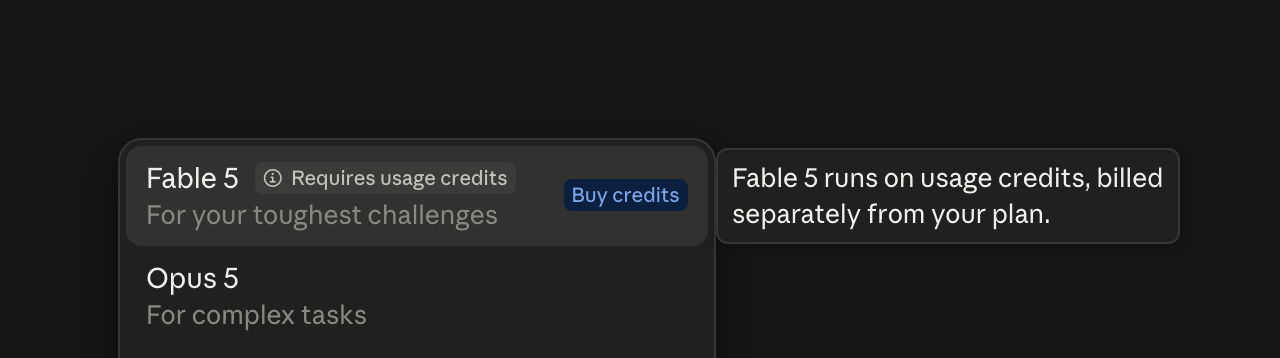
Fable 5 is Anthropic's most capable model, built for work that runs long and can't lose the thread. If your task fits that shape, the extra cost is easy to justify.
Long, autonomous projects
Fable 5 can run in an agent harness like Claude Code for days at a time, planning across stages and checking its own work. That matters for the kind of project a small team would otherwise chip away at for weeks, like restructuring a knowledge base or auditing a year of contracts.
The hardest, highest-stakes work
Fable 5 is Anthropic's top-tier model for the most demanding coding tasks and knowledge work it offers. When a task is genuinely at the edge of what any model can do, and getting it right matters more than the cost, Fable 5 is the one built for that ceiling.
Where it doesn't apply
Fable 5 includes safeguards for cybersecurity and biology. Flagged cybersecurity requests fall back automatically to Opus 4.8, and flagged biology requests fall back to Opus 5. You won't be charged Fable 5 rates when either happens. None of this affects normal content, ops, or HR work, but it's worth knowing about if your team touches security tooling.
For most founders and remote teams, this is a small slice of the work you do. That's exactly why the next model matters more.
When Claude Opus 5 Is the Better Choice
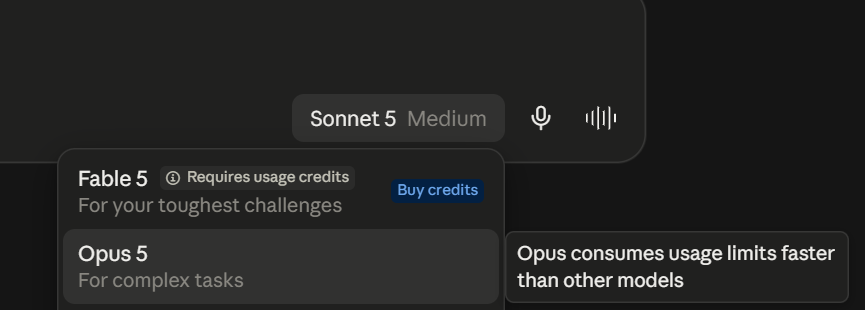
Opus 5 launched in July 2026 and for most day-to-day work, it's the model your team should default to.
Everyday content and ops work
Drafting posts, summarizing documents, prepping onboarding materials, building out SOPs. Work like this doesn't need Fable 5's ceiling, and Opus 5 handles it well at half the cost.
Opus 5 runs at $5 per million input tokens and $25 per million output tokens, exactly half of Fable 5's rate.
Fast turnaround and high volume
If you're running requests often, whether that's daily content production or repeated internal reporting, the cost difference compounds fast. Opus 5 also includes effort settings, so you can dial reasoning up or down depending on how demanding a given task is, instead of switching models entirely.
Work that needs zero data retention (ZDR)
Opus 5 supports zero data retention. This means Anthropic doesn't store your prompts or outputs after your session ends.
Fable 5 requires 30-day data retention for safety monitoring, with no ZDR option. For teams with compliance requirements around what happens to their data, that difference alone settles the choice.
The default, not the exception
Anthropic built Opus 5 to come close to Fable 5's capability at half the cost. That's why it makes sense to treat Opus 5 as your starting point and reserve Fable 5 for the harder edge cases covered above.
💡 Pro tip: Your best Claude input is already in your meetings. Connect Tactiq via MCP and ask Claude to summarize your last call or pull action items. Learn how to connect Tactiq to Claude →
Can Claude AI Take Meeting Notes?
Both Claude models are only as useful as the context you give them. Claude can't join a meeting or capture what was said; it needs the transcript first. That's the gap Tactiq fills.
Tactiq is a Chrome extension that transcribes your meetings in real time across Zoom, Google Meet, and Microsoft Teams. The transcript is ready the moment your call ends, with speaker labels intact.
Connect Tactiq to Claude with MCP
Whether you're running agentic tasks across a long project or wrapping up everyday knowledge work, both Claude models work from whatever context you give them. Meeting transcripts are some of the most valuable context your team generates, and most of it disappears the moment the call ends.
Tactiq connects directly to both AI models through MCP, the open standard Anthropic built to link Claude to external tools and data. Connect once, and either model can pull your meeting history directly into any prompt.
Once connected, you can ask Claude to:
- Summarize your last call and pull out action items by owner
- Find a decision made three weeks ago without digging through notes
- Turn meeting outcomes into a report or summary without starting from scratch
Tactiq is listed in Claude's Connectors Directory, so setup takes two clicks:
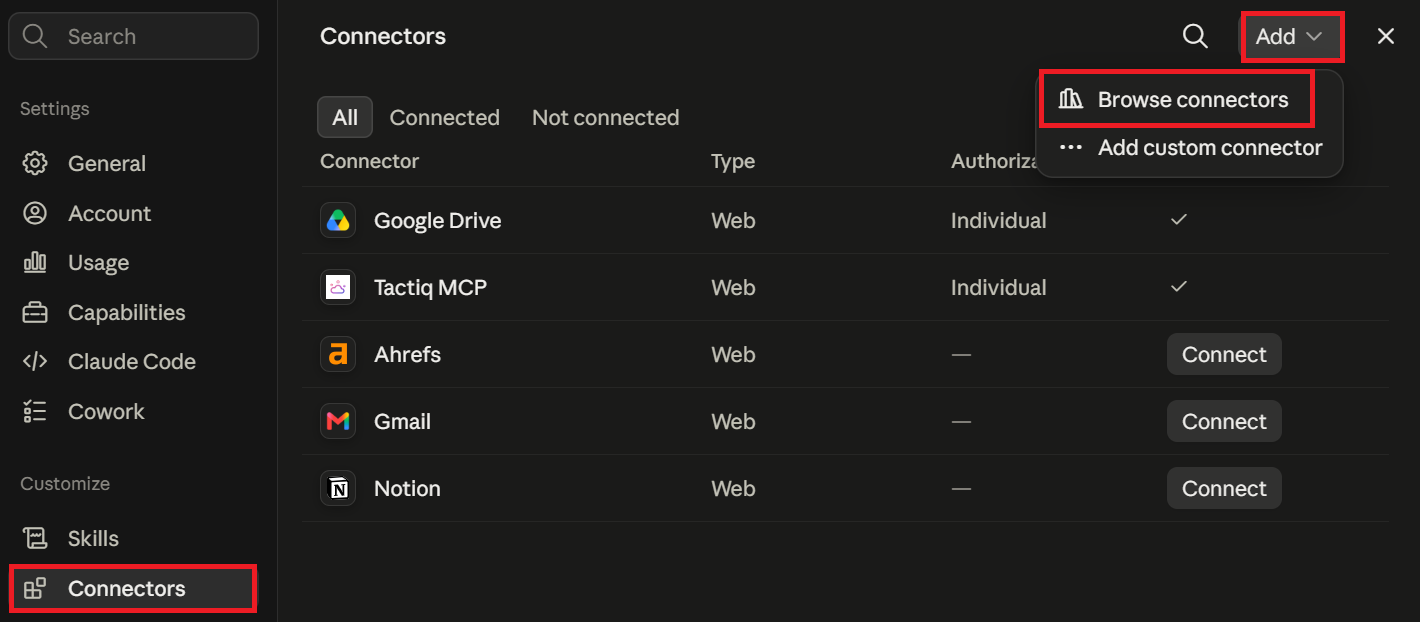
- Go to Customize > Connectors in Claude and click Add > Browse connectors
- Search for Tactiq, click Connect, then click Allow to authorize
For team-wide setup, a Workspace Owner adds Tactiq once under Organization settings > Connectors. Each member then goes to Customize > Connectors and clicks Connect to link their own account.
For a deeper look, see the best connectors for Claude.
Install the Tactiq Chrome extension free →
{{rt_cta_ai-convenience}}
Fable 5 or Opus 5: Which Claude Model Should You Use?
The choice between the two models is simpler than it looks.
Opus 5 is the better default model for most teams. It handles everyday content, knowledge work, and high-volume tasks, with zero data retention available.
Fable 5 earns its premium on the hardest, longest-running work where no cheaper model keeps up. Start on Opus 5. Move to Fable 5 only when the task genuinely needs it.
Whichever model you're running, feed it clean input. The clearest winner in any Claude comparison is the context you give it, not the model.
It depends on the task. Fable 5 leads on long, autonomous, high-stakes work. Opus 5 matches it on most everyday tasks at half the cost, making it the better default model for most teams.
Fable 5 is a Mythos-class model built for agentic tasks and complex coding that other Claude models can't sustain. If task completion on the hardest work matters more than price, the gap justifies it.
Yes. Fable 5 was briefly offline from June 12 to June 30, 2026, due to export controls, then fully restored on July 1st. It's available to Pro, Max, Team, and Enterprise users today.
Yes. Opus 5 is a cheaper model that comes close to Fable 5 on most tasks, supports zero data retention, and includes effort settings to control cost. It's the right starting point for almost everyone.
Connect Tactiq to Claude via MCP. Tactiq transcribes your Zoom, Google Meet, or Teams calls and feeds them directly into either model. No copy-paste needed.
Related articles








Want the convenience of AI summaries?
Try Tactiq for your upcoming meeting.
Want the convenience of AI summaries?
Try Tactiq for your upcoming meeting.
Want the convenience of AI summaries?
Try Tactiq for your upcoming meeting.