
Claude vs ChatGPT vs Gemini: Which AI Writes Best in 2026?
- Published:
- April 5, 2026
- Updated:
- October 8, 2026
Claude, ChatGPT, and Gemini each promise to speed up your writing, improve your drafts, and help you generate content faster than ever. But here's the problem: they don't all write the same way.
Each tool has a distinct personality and different strengths. Performance varies a lot depending on what you're trying to write. This isn't a feature-list comparison or a generic "AI is amazing" article. This is a practical guide for business owners, content marketers, and professionals who need to know which tool will actually improve their writing.
In this article, you'll learn:
- How Claude, ChatGPT, and Gemini each approach the craft of writing, and where their personalities diverge
- Which AI wins for specific writing tasks like long-form content, business emails, blog posts, and content repurposing
- What you get for each on the free and paid plans
- How to turn meeting transcripts into polished writing using Tactiq with these AI tools
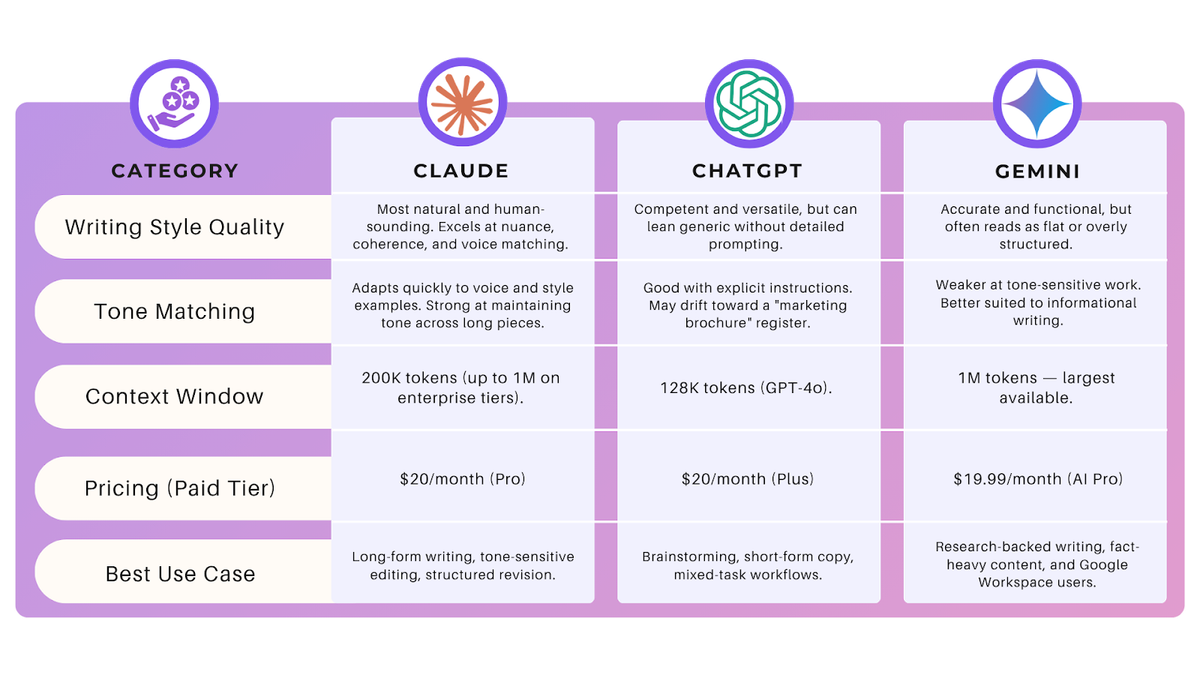
Claude vs ChatGPT vs Gemini for Writing — Quick Comparison
For the readers who need the answer now, here's the side-by-side breakdown:
Pro Tip 💡: Want to make your content sound closer to your own writing or company branding? Feed your meeting transcript from Tactiq to Claude, Gemini, or ChatGPT to create a Style in your own voice.
Claude — The Natural Writer
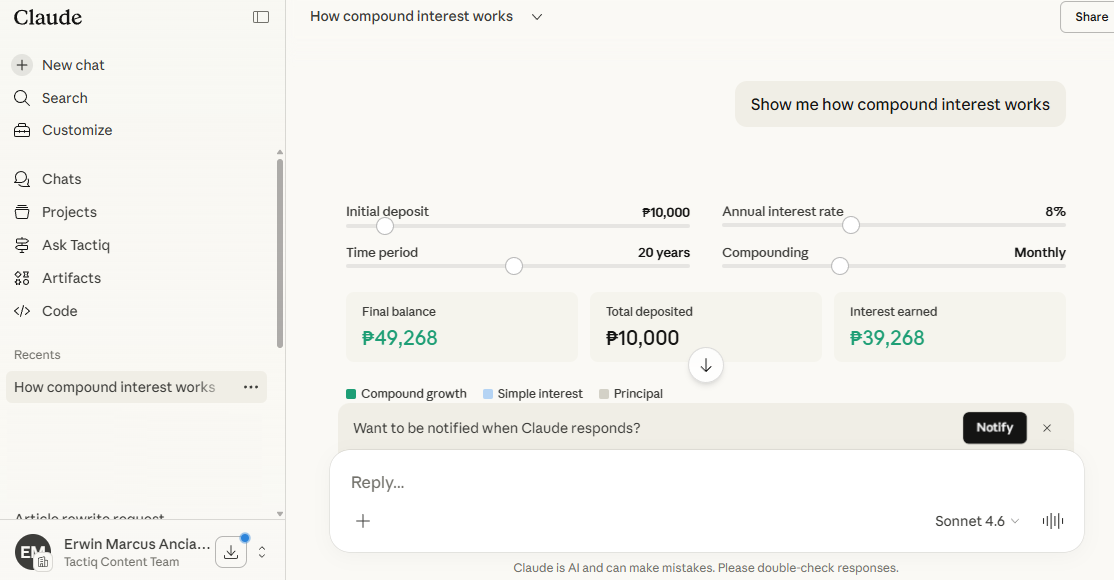
Claude has earned a reputation as the strongest pure writer among the three major AI assistants. Where other models produce text that sounds like text, Claude's output tends to read like something a thoughtful person actually wrote.
Claude’s greatest strength is voice matching. Give Claude a sample of your writing style, and it adapts with surprising accuracy. It picks up on your rhythm, sentence variety, and your vocabulary.
It also has long-form coherence: Claude maintains tone and argument structure across thousands of words without drifting into repetition or losing the thread.
Lastly, Claude handles subtlety well. It can write a paragraph that sounds confident without being aggressive, or casual without being sloppy.
In blind writing tests, Claude has consistently outperformed its competitors in terms of prose quality. In a community-run test comparing different AI’s output on eight writing prompts, the judges found that Claude took first place in half the rounds, often winning by significant margins. Its writing felt more intentional and less generic.
Claude is also built for revision-heavy workflows. If your writing process involves multiple passes — tightening structure, adjusting tone, sharpening arguments — Claude handles that iterative loop better than most. It's less about generating a first draft and more about collaborating on the writing itself.
Where Claude falls short: It can be slower than ChatGPT on quick-turnaround tasks, and its built-in tools ecosystem is narrower.
ChatGPT — The Versatile All-Rounder
ChatGPT remains the most widely used AI assistant in the world, and its writing capabilities reflect that breadth. It's not the best pure writer, but it's arguably the most flexible. Need a tagline, a product description, an email draft, and a brainstorm list in the same session? ChatGPT handles that context-switching smoothly.
Its strength lies in speed and iteration. ChatGPT is fast at generating options and producing workable first drafts that you can shape into something better.
For marketing copy, especially like social posts, ad variations, and landing page headlines, it's a strong choice.
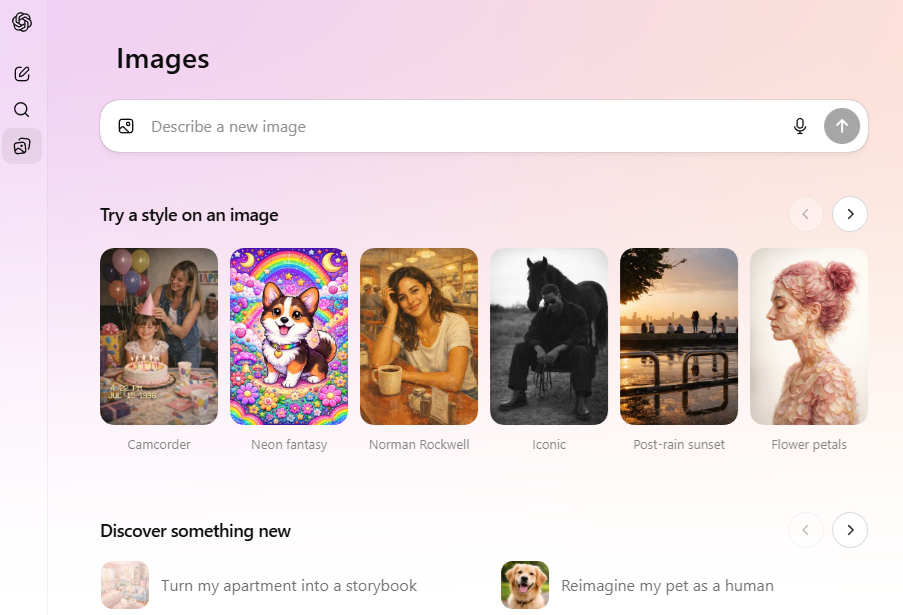
ChatGPT also benefits from the broadest tool ecosystem of the three. With built-in image generation through DALL-E, web browsing, code execution, and a deep research mode, it functions as a one-stop workspace for professionals who move between different task types throughout the day.
Where ChatGPT falls short: Without strong prompting, its writing can feel generic. It tends to sound upbeat, with a slightly corporate tone that experienced writers can recognize easily. Some writers run these drafts through tools like UndetectedGPT (opens in a new tab) to smooth out that recognizable AI tone before publishing. For work that demands a specific voice or sustained literary quality, you'll spend more time coaching ChatGPT than you would with Claude.
Gemini — The Research-Backed Writer
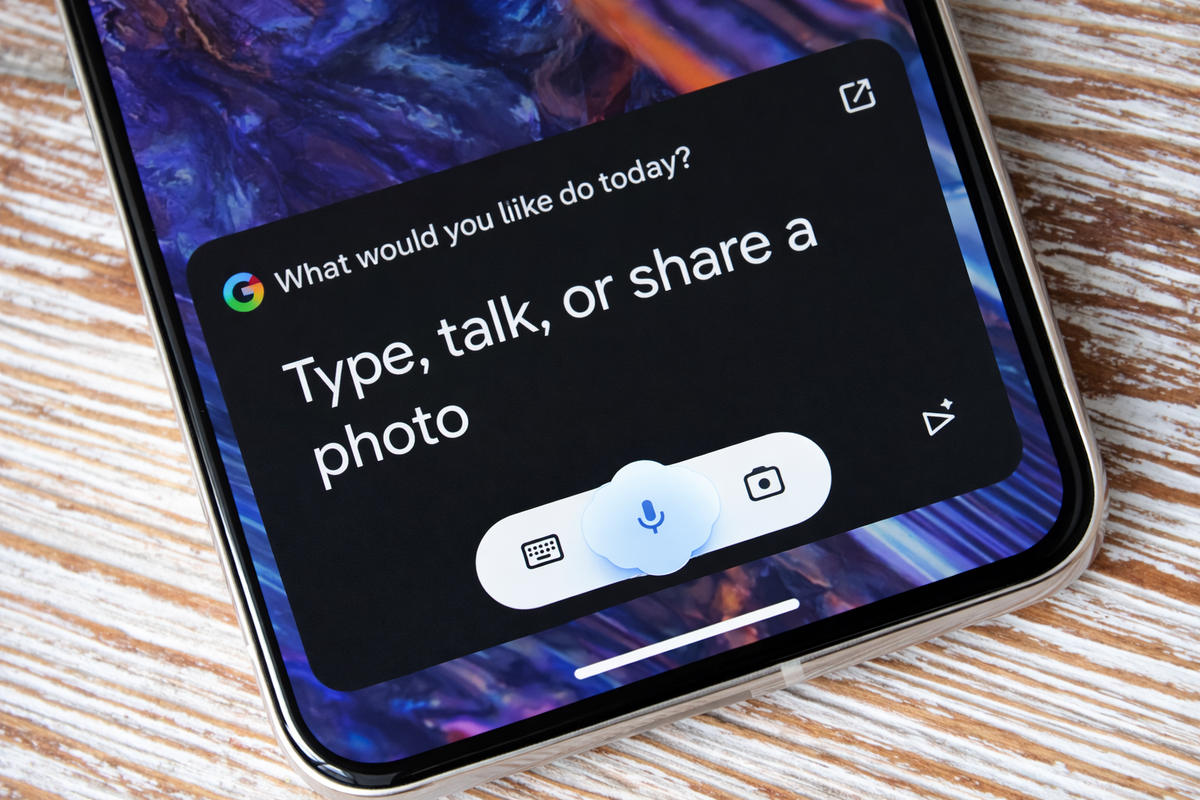
Google's Gemini occupies a different niche. It's not trying to be the most elegant writer — it's trying to be the most informed one. It offers real-time access to Google Search and tight integration with Google Workspace (Docs, Gmail, Sheets, Drive). Gemini is strongest when writing needs to be grounded in current data or woven into an existing productivity workflow.
Its massive one-million-token context window is a genuine differentiator. You can feed Gemini an entire research corpus, a full company handbook, or hours of transcript material and ask it to synthesize. For research summaries, data-driven reports, and content that needs to cite recent sources, Gemini has a structural advantage.
Gemini also shines for teams that already live in the Google ecosystem. The ability to work directly inside Google Docs — drafting, editing, and querying your own Drive files without leaving the application — reduces the friction of copy-pasting between tools.
Where Gemini falls short: Tone-sensitive writing is its weakest area. Its output tends to be accurate but functional, reading more like a well-organized briefing document than a piece of writing someone would enjoy reading. If you need strong brand content, thought leadership, or anything that needs a personality, Gemini's drafts require heavy editing to make the grade.
Which AI Wins for Each Writing Use Case?
Creative Writing & Long-Form Content
Winner: Claude
For essays, narratives, thought leadership pieces, ghostwritten articles, and any writing that needs to sustain quality over thousands of words, Claude is the clear choice. It maintains coherence across long documents, handles stylistic nuance well, and produces prose that requires less cleanup. Its strength in iterative revision also means you can work through multiple drafts without the output degrading in quality.
ChatGPT is a reasonable second choice here, especially if your creative work involves brainstorming and rapid ideation before settling into a longer draft. Gemini's large context window is useful for reference-heavy creative projects, but its prose quality lags behind.
Business Writing (Emails, Reports, Proposals)
Winner: ChatGPT
For the volume and variety of everyday business writing — quick emails, internal updates, meeting agendas, slide decks — ChatGPT's speed and flexibility make it the most efficient choice. It handles format-switching well, and its built-in tools let you move from drafting a report to analyzing a spreadsheet without leaving the interface.
There’s just one caveat: for high-stakes business writing — board reports, executive proposals, client-facing documents where tone and precision matter — Claude produces tighter, more polished output. If the writing needs to be good, not just done, Claude is worth the extra time.
Gemini earns a mention for teams running on Google Workspace. Drafting proposals directly in Google Docs with Gemini's assistance eliminates the export step altogether.
Content Marketing & Blog Writing
Winner: It depends on the stage
The honest answer is that no single tool dominates every phase of content marketing. The most effective approach combines tools based on where you are in the workflow.
For ideation and outlining, ChatGPT's brainstorming speed is unmatched. It generates angles, headlines, and structural options quickly. For the actual writing — turning an outline into a polished draft that sounds human and holds the reader's attention — Claude consistently produces stronger output. For content that needs to be anchored in current data, trends, or competitor research, Gemini's search integration gives it a natural edge.
Many content teams are finding that the best results come from using two or even all three tools at different stages rather than committing to a single platform.
Summarizing and Repurposing Content
Winner: Gemini (for volume), Claude (for quality)
Gemini's enormous context window makes it the best tool for ingesting large volumes of source material — long reports, multi-hour transcripts, entire content libraries — and producing summaries. If your job involves turning a 50-page research document into a two-page executive brief, Gemini handles the condensing well.
Claude wins when the summary itself needs to be well-written. If you're repurposing a webinar transcript into a blog post or turning a strategy session into a client-facing document, Claude's prose quality ensures the output doesn't read like a machine-generated summary.
ChatGPT sits comfortably in the middle, handling both tasks adequately if not exceptionally.
Want the convenience of AI summaries?
Try Tactiq for your upcoming meeting.
Claude vs ChatGPT vs Gemini Pricing: Free and Paid Plans
All three platforms have converged on strikingly similar pricing, which makes the decision less about budget and more about which tool's strengths match your needs. For most writers, the $20/month tier on any of these platforms is the sweet spot. The free tiers are surprisingly capable for occasional use, but paid plans unlock the flagship models and higher usage limits that make a real difference in daily writing workflows.
The free tiers are worth testing before you commit. Claude's free Sonnet access, ChatGPT's GPT-5.3, and Gemini's base model all give you a genuine feel for each tool's writing personality without spending anything.
How Tactiq makes meetings easy with these AI Tools
AI comparisons focus on the quality of each tool, but as professionals, what matters is our use case for them, and how we can leverage them to make our jobs easier. This is where Tactiq shines: connecting your business meetings to different AI tools.
Tactiq is a Chrome extension that provides real-time transcription for meetings on Zoom, Google Meet, and Microsoft Teams. It works without a bot and produces timestamped, speaker-identified transcripts that are available the moment your call wraps up.
The real power isn't just the transcript itself. It's what you can do with that transcript when you pair it with Claude, ChatGPT, or Gemini.
Follow-up emails and meeting summaries. Instead of scribbling notes and reconstructing what was discussed, feed your Tactiq transcript into Claude or ChatGPT and ask for a concise summary with action items. You'll get a clean follow-up email in seconds rather than spending 15 minutes writing one from memory.
Stakeholder reports. Take a transcript from a weekly project standup or a quarterly review and send it to Gemini or Claude. Ask for a structured report with key decisions, risks flagged, and next steps organized by owner. What used to be an hour of documentation becomes a five-minute task.
Blog posts and content briefs from strategy calls. Content teams sit in planning meetings full of ideas, angles, and audience insights that never make it into a brief. Tactiq captures the conversation and sends it to Claude, prompting it to extract content themes, draft blog outlines, or even produce a first draft based on the strategic direction discussed in the call.
Proposals from client discovery calls. Sales and account teams can transcribe discovery calls with Tactiq, then feed the transcript into ChatGPT or Claude to draft a proposal that directly mirrors the client's language, concerns, and priorities. The result is a proposal that feels tailored, because it literally draws from the client's own words.
Tactiq supports exporting transcripts to Google Docs, Notion, Slack, and CRM tools like HubSpot and Salesforce, which means it fits into whatever workflow you're already running. The transcripts work equally well as input for Claude, ChatGPT, or Gemini — the tool isn't tied to any single AI platform.
For teams that produce a lot of written content from meetings, Tactiq captures the meeting content that AI tools need to write effectively, so nothing gets lost between the conversation and the draft.
Claude vs ChatGPT vs Gemini: Which AI Should You Use for Writing?
After breaking down the writing capabilities, testing the use cases, and comparing what you get for your money, the answer is clear — but it's not a single answer.
Claude is the best AI for writing quality. If your primary goal is producing prose that sounds human, holds together over length, and requires minimal editing, Claude should be your default. It's the tool that best understands the craft of writing — not just the task of generating text.
ChatGPT is the best AI for writing flexibility. If your day involves bouncing between brainstorms, emails, copy variations, and research — and you want one tool that handles all of it — ChatGPT's breadth is unmatched. It's the generalist's pick.
Gemini is the best AI for research-informed writing. If your writing lives in Google Workspace, draws heavily on current data, or involves processing large volumes of reference material, Gemini's integrations and context window give it a structural edge.
And for teams that write from meeting content — whether that's turning calls into reports, transcripts into blog posts, or discovery sessions into proposals — Tactiq is the missing piece that makes all three tools work better. No AI can write effectively from information that was never captured. Tactiq ensures it is.
The smartest writers in 2026 aren't choosing one tool. They're choosing the right tool for each task and feeding it the best possible input.
FAQs
Which AI is best for creative writing?
Claude is widely regarded as the strongest AI for creative writing. It produces the most natural-sounding prose, handles voice and tone matching well, and maintains quality over long-form pieces.
Is Claude better than ChatGPT for writing?
For pure writing quality, yes. Claude produces more natural, nuanced prose and is better at maintaining tone consistency across long documents. ChatGPT is better for speed, versatility, and workflows that involve more than just writing.
ChatGPT vs Gemini vs Claude — which is free?
All three offer free tiers. Claude's free plan gives access to its Sonnet model with daily message caps. ChatGPT's free tier provides GPT-5.3 access with usage limits. Gemini's free tier requires a Google account and provides access to the base model.
Which AI writes the most naturally?
Claude, more consistently. Multiple independent evaluations and blind user tests have found that Claude's writing reads as the most human. ChatGPT has a slightly robotic, overly enthusiastic tone, while Gemini is functional but flat.
Can I use meeting transcripts for AI writing?
Absolutely, and this is one of the most underused AI writing strategies. Tools like Tactiq transcribe meetings on Zoom, Google Meet, and Microsoft Teams in real time, producing text you can immediately feed into Claude, ChatGPT, or Gemini.
Related articles
Context Engineering vs Prompt Engineering: What Your AI Agents Are Missing

Claude Memory: How to Import and Manage Your AI Context

Claude Cowork Connectors: Automate Recurring Work

Google Gemini MCP Support: Where It Works and Setup Tips

Best Claude Skills: Top Picks for Meetings, Content, and Code

5 Best AI Scheduling Assistants

Microsoft Teams MCP: How to Access Meeting Content With AI

How Do I Turn Off Google Gemini?
Want the convenience of AI summaries?
Try Tactiq for your upcoming meeting.
Bringing AI into your meetings has never been so easy.
Add to Chrome - It's free!(opens in a new tab)Try Tactiq in your upcoming meeting!
Sign up now