
Can Claude AI Take Meeting Notes?
March 2, 2026
March 2, 2026
April 14, 2026
April 14, 2026

Claude is one of the most capable AI tools available right now, but it cannot join your meetings. It has no way to capture live conversation, and it won't automatically generate notes from a call. What it can do is analyze, summarize, and organize meeting transcripts with impressive detail.
That matters if you're trying to build a smarter meeting workflow. Claude needs a transcript to work with. Once it has one, it can extract action items, highlight key takeaways, draft follow-up emails, and create structured meeting minutes in a few minutes.
The real question is how you get your meeting transcripts into Claude efficiently. That's where the workflow matters.
This article walks you through:
- What Claude can and can't do for meeting notes
- The limitations to know before you rely on it
- A step-by-step guide to using Claude for meeting notes manually
- How Tactiq and Claude work together for a faster, more complete workflow
- Example prompts to get the best output from Claude

What Can Claude AI Actually Do for Meetings?
Claude is not a meeting tool by default. It doesn't connect to Zoom, Google Meet, or Microsoft Teams. It can't listen to audio or join a call. But once you give it a transcript, it becomes one of the most effective AI tools for post-meeting analysis.
What Claude does well
The biggest advantage Claude has over other AI tools is its large context window. It can process long, detailed transcripts without losing track of the discussion. That means it can pull key points from a 90-minute call just as accurately as a 20-minute one.
Here's what Claude handles well once it has your meeting transcript:
- Summarizing transcripts into concise, structured summaries that capture the key takeaways without the noise
- Extracting action items and next steps so nothing gets missed after the call
- Assigning action items to the right people based on the meeting context
- Drafting follow-up emails and stakeholder updates from the discussion
- Generating meeting minutes that document decisions, conclusions, and discussion topics in a format teams can actually use
- Organizing notes by theme, project, or agenda item for easier review
- Identifying deadlines mentioned during the meeting and surfacing them clearly
For companies running discovery calls, interviews, or weekly team meetings, Claude can turn a raw transcript into a comprehensive first draft of your notes in seconds.
Check out these Claude project examples for your recurring workflows to see what's possible.
New to Claude Projects? This step-by-step video walks you through setting one up. The same approach works for meeting notes, blog writing, and any recurring workflow.
Limitations of Using Claude AI for Meeting Notes
Claude is a capable AI, but it has real gaps when it comes to meeting workflows. Before you build your process around it, these are the limitations worth knowing.
It requires manual steps to get the transcript in
Claude can't automatically pull your meeting transcript. You have to export it, copy it, or upload it yourself. For back-to-back calls, that adds up fast.
There's no real-time capture
Claude works with the text you give it, not live audio. It can't transcribe a meeting as it happens, which means you always need a separate tool to capture the conversation first.
It has limited memory across meetings by default
Claude's memory feature is available on paid plans, but it's opt-in and not automatic for everyone. Free users still start each session with a blank slate. Even with memory enabled, Claude doesn't store meeting-specific context unless you've actively shared it in a previous session.
Direct integrations require a paid plan and setup
Claude now connects to tools like Asana, Linear, Slack, and HubSpot via its Connectors feature, but this requires a paid subscription and some configuration. Free users still need workarounds like Zapier to push action items into other tools. See a full breakdown of Claude's pricing plans to find the right tier for your team.
Poor transcript quality leads to poor output
Claude can only work with what you give it. If your transcripts are full of errors or unclear attribution, the summary and action items it generates will reflect that.
Data privacy is worth considering
Pasting full meeting transcripts into any AI tool raises security questions, especially for customer calls or sensitive business discussions. Review your company's data privacy policies before making this a standard practice.
How to Use Claude AI for Meeting Notes (Step-by-Step)
Claude doesn't connect to your meetings directly, so getting your notes into Claude takes a few manual steps. Here's how the process works.
Step 1 – Get your meeting transcript
Before Claude can do anything, you need a transcript. Zoom, Google Meet, and Microsoft Teams all let you download a transcript or recording after the call. From there, you'd extract the text and prepare it for Claude yourself.
The quality of your transcript matters here. If it's full of errors or missing context, Claude's output will reflect that. A clean, accurate transcript leads to better summaries, cleaner action items, and more useful meeting minutes.
Step 2 – Upload the transcript to Claude
Once you have your transcript, paste it into Claude or upload it as a PDF. If you're using Tactiq, you have a few more options for getting your transcript into Claude, covered in the next section.
For best results, remove any filler text or system messages before uploading. The cleaner the transcript, the more accurate Claude's output will be.
💡 Pro tip: Spending too much time cleaning up messy transcripts before uploading them to Claude? Tactiq captures meeting audio in real time and automatically produces clean, accurate transcripts, ready to drop straight into Claude.
Step 3 – Prompt Claude for what you need

A well-structured prompt gets you a polished first draft of your meeting notes in seconds. Here are some example prompts to get you started:
- Meeting summary: "Summarize this meeting transcript. Focus on key decisions, main discussion topics, and any conclusions reached."
- Action items: "Extract all action items from this transcript. List each task, who is responsible, and any deadlines mentioned."
- Follow-up email: "Draft a follow-up email based on this transcript. Include a short summary, next steps, and assigned tasks."
- Meeting minutes: "Create formal meeting minutes from this transcript. Include the agenda, key points discussed, decisions made, and action items with owners."
For better results, be specific about the format you want. If the meeting covered multiple projects, ask Claude to organize notes by topic. If you need a concise stakeholder update, say so. Claude will adjust the detail and length accordingly.
How Tactiq Creates a Complete Meeting Workflow with Claude AI
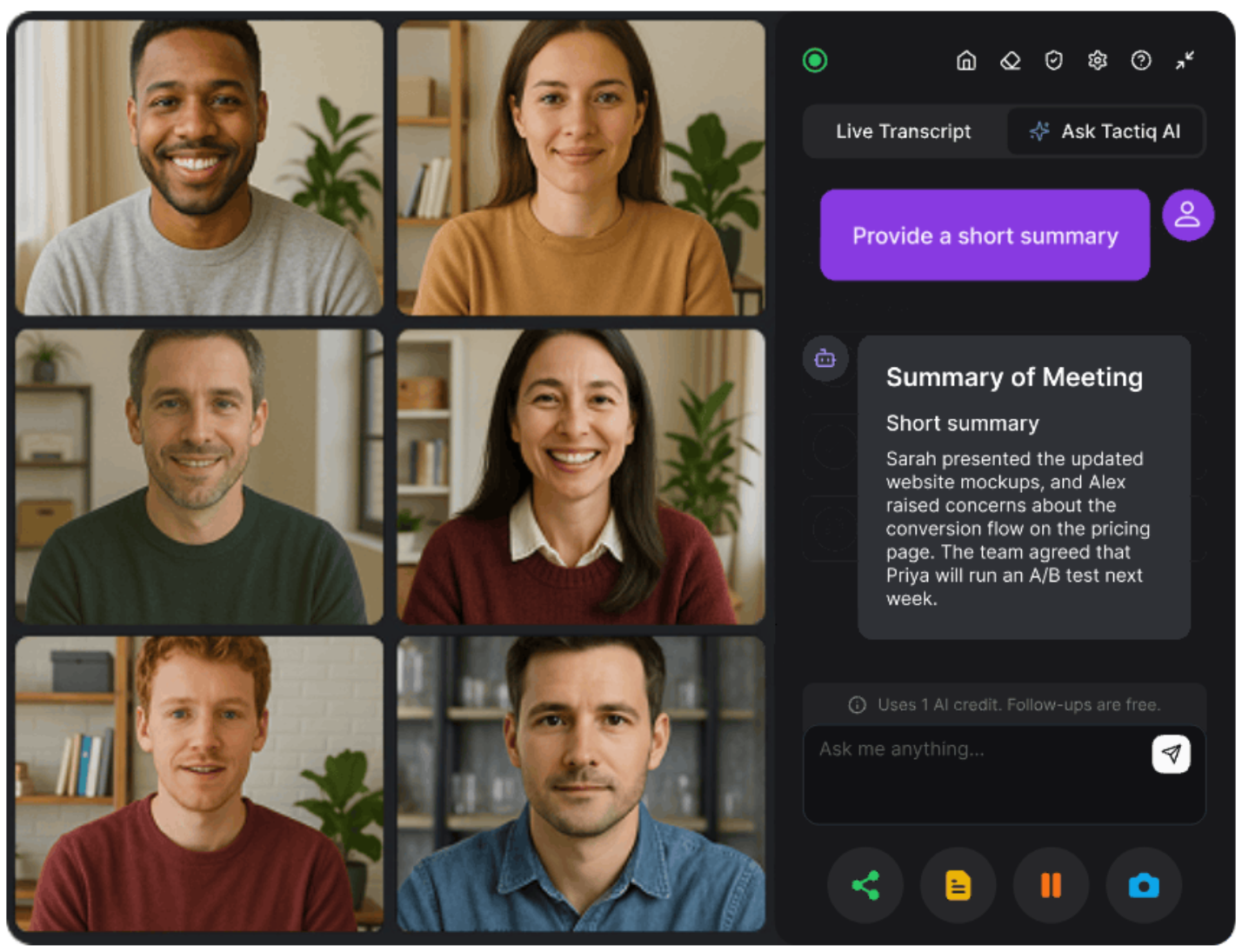
The step-by-step process above works, but every stage is manual. You have to wait for the recording, download the file, extract the text, clean it up, and then paste it into Claude. For one meeting a week, that's manageable. For teams running multiple calls a day, it becomes a real time drain.
Tactiq removes those steps entirely. It's a Chrome extension that captures meeting transcripts in real time across Zoom, Google Meet, and Microsoft Teams. No bots, no recordings, no extra setup. Install it once, and it starts transcribing automatically every time you join a call. By the time the meeting ends, your transcript is clean, timestamped, and ready to send straight to Claude.
Ways to get your Tactiq transcript into Claude
- Copy and paste. Open your Tactiq transcript, copy the text, and paste it into Claude. Quick and works on any plan.
- Export as PDF. Download your transcript as a PDF and upload it to Claude. A good option for longer calls where you want to keep full detail intact.
- Automate with Zapier. Set up a Zap that automatically sends your Tactiq transcript to Claude after every meeting.
What you can accomplish with Tactiq and Claude together
Combining both tools automates most of your post-meeting workflow. Once Tactiq delivers a clean transcript to Claude, you can walk away with:
- A structured meeting summary that captures key takeaways and discussion topics
- A clear list of action items with owners and deadlines
- A follow-up email is drafted and ready to send
- Formal meeting minutes documenting decisions, conclusions, and agenda items
The whole process takes minutes instead of hours, and none of it requires manual note-taking during the call.
{{rt_cta_ai-convenience}}
Beyond Claude – Tactiq's AI handles the entire post-meeting workflow
Claude is a strong choice for teams already using it across other workflows. But if you'd rather keep everything in one place, Tactiq's own AI handles the entire post-meeting process without switching tools.

Tactiq generates AI summaries, lets you run custom prompts on any transcript, and offers pre-built AI Workflows that push insights directly to Slack, HubSpot, Linear, and more. No extra steps, manual exports, or additional tools required.
Ready to try it? Install the Tactiq Chrome extension for free and start capturing your next meeting in minutes.
Getting Started with Claude and Tactiq
Claude is a capable post-meeting AI tool, but it has one hard requirement: it needs a transcript to work. Without one, there's nothing for it to analyze, summarize, or act on. The manual process of exporting, cleaning, and uploading transcripts works, but it adds friction to every single meeting.
Tactiq removes that friction. It captures your meeting transcript in real time across Zoom, Google Meet, and Microsoft Teams, and gets it Claude-ready the moment your call ends. From there, Claude can generate summaries, extract action items, assign tasks, draft follow-up emails, and build formal meeting minutes, all from a single prompt.
Together, the two tools cover the full meeting workflow from live conversation to structured notes, without the manual steps slowing you down. If your team also uses ChatGPT, here's how to use ChatGPT for meeting minutes.
And if you'd rather skip Claude entirely, Tactiq's own AI handles the summaries, action items, and workflows on its own. It pushes insights directly to the tools your team already uses.
Try Tactiq free and capture your next meeting in minutes. Let Tactiq handle the transcript, and let Claude, or Tactiq's built-in AI, handle the rest.
FAQs on Claude for Meeting Notes
Can Claude AI take meeting notes in real time?
No. Claude can't join meetings or capture live audio. It needs a transcript to generate notes, summaries, or action items.
How do I use Claude to summarize a meeting?
Export or copy your meeting transcript, paste it into Claude, and prompt it to summarize. For example: "Summarize this transcript and highlight the key decisions and action items."
Can Claude transcribe audio or video from a meeting?
No. Claude doesn't process audio or video files. You need a separate transcription tool like Tactiq to convert your meeting into text first.
What are the limitations of Claude for meeting notes?
Claude requires a transcript to work, has no real-time capture, and needs manual steps to get your transcript in. Memory and direct integrations are limited to paid plans.
Is Claude better than dedicated AI meeting note-taking tools?
Claude is more flexible for analysis and custom prompts, but it lacks real-time transcription and native meeting integrations. Tools like Tactiq handle transcription automatically and include AI summaries. Not sure whether Claude or ChatGPT is the better fit for your team? Here's a full breakdown of ChatGPT vs Claude.
Related articles








Want the convenience of AI summaries?
Try Tactiq for your upcoming meeting.
Want the convenience of AI summaries?
Try Tactiq for your upcoming meeting.
Want the convenience of AI summaries?
Try Tactiq for your upcoming meeting.