
Zoom Meeting Statistics 2026: Usage, Revenue & Data
- Published:
- July 16, 2026
- Updated:
- September 30, 2026

Zoom has moved well past its pandemic-era reputation as a temporary fix for in-person meetings. In 2026, it operates as a mature, revenue-generating platform, competing directly with Microsoft Teams and Google Meet in the growing video conferencing market.
Here's what this article covers:
- Zoom's usage and adoption trends in 2026
- Revenue, growth, and market share data
- How people actually behave in Zoom meetings
- Meeting fatigue and productivity statistics tied to video meetings
The numbers below tell two different stories. Zoom's business is steady and still growing. The way people actually experience meetings is a lot messier.
TL;DR: Zoom Meeting Statistics
Zoom's last public daily-user figure remains 350 million meeting participants from December 2020, with no fresher number released since, and market share estimates for Zoom range widely from 28% to over 55% depending on the source.
Meeting fatigue remains a defining workplace issue. Employees spend an average of 392 hours a year in meetings, and 71% of senior managers call their own meetings unproductive and inefficient.
Zoom Usage & Adoption Statistics
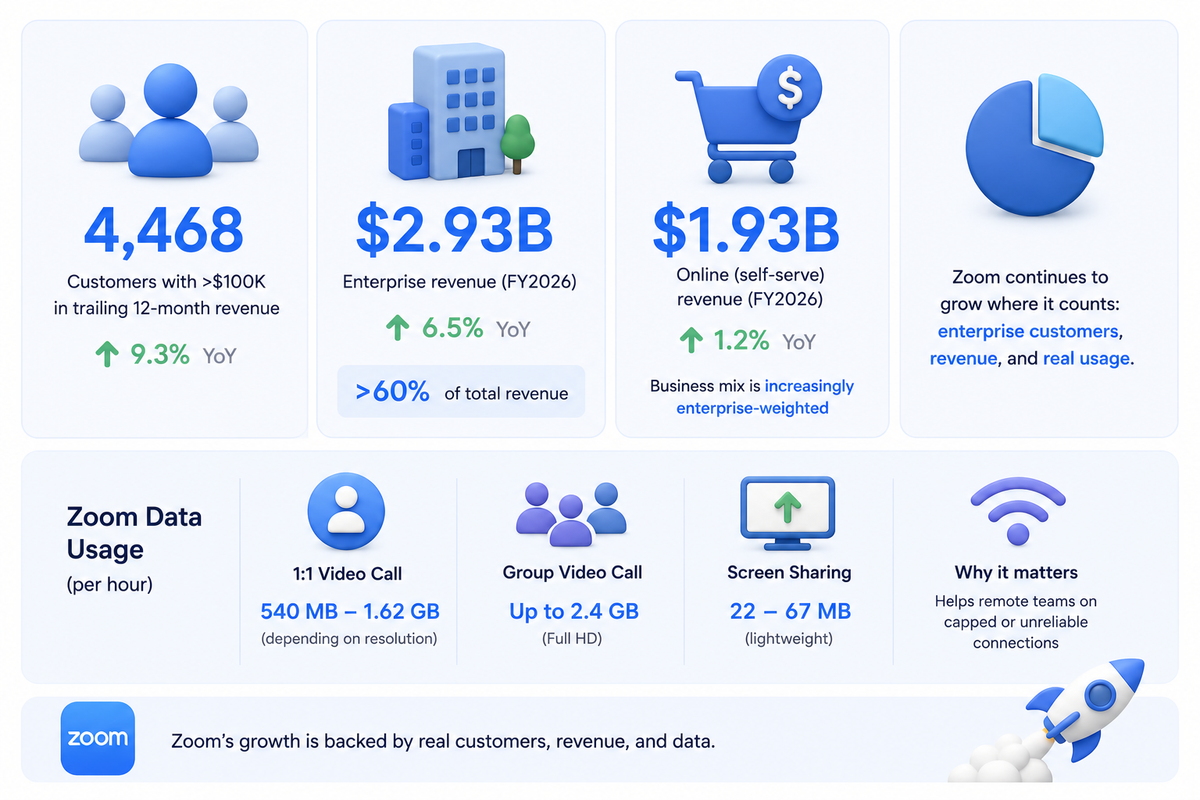
Zoom's daily user counts made headlines during the pandemic, but the company hasn't published fresh figures on active users or daily meeting participants since 2020. What it does report, consistently and on the record, is customer growth and revenue tied to actual usage.
That data tells a clearer story about who's still relying on Zoom and how deeply it's embedded in day-to-day work.
- Zoom closed fiscal year 2026 with 4,468 customers contributing more than $100,000 each in trailing 12-month revenue, up roughly 9.3% year over year, according to Zoom's Q4 and full-year 2026 results (opens in a new tab).
- Enterprise (opens in a new tab) revenue reached $2.93 billion for fiscal year 2026, up 6.5% year over year, now making up more than 60% of Zoom's total revenue, per the same SEC filing (opens in a new tab).
- Online (self-serve) revenue came in at $1.93 billion for the fiscal year, up 1.2% year over year, reflecting a business mix that's increasingly enterprise-weighted rather than individual or small-team driven.
- Zoom's own data usage guidance (opens in a new tab) shows a one-on-one video call can use between 540 MB and 1.62 GB per hour depending on resolution, while a group call can reach up to 2.4 GB per hour at full HD, a detail that matters for remote teams on capped connections or unreliable networks.
- Screen sharing remains one of the lightest-weight features on the platform, using only 22 to 67 MB per hour compared to well over 1 GB for full HD video.
Zoom Revenue & Market Share Statistics
Fiscal year 2026 marked a return to accelerating growth for Zoom, with the company crossing several financial milestones on its way toward a $5 billion run rate.
- Zoom generated $4.87 billion in total revenue for fiscal year 2026, up 4.4% year over year, according to Zoom's Q4 and full-year 2026 results (opens in a new tab).
- Net income nearly doubled to $1.9 billion for the fiscal year, up from $1.01 billion the previous year, per the same filing (opens in a new tab).
- Zoom expects to surpass $5 billion in revenue during fiscal year 2027, based on guidance issued alongside its FY2026 earnings report (opens in a new tab).
- The global video conferencing market was valued at $11.65 billion in 2024 and is projected to reach $13.07 billion in 2025, growing at a compound annual rate of 8.2% through 2033, according to Grand View Research (opens in a new tab).
Market share estimates for Zoom as video conferencing software vary significantly across third-party research firms, ranging from roughly 28% to over 55%. This is because Zoom does not publish an official market share figure and firms use different measurement methods (by revenue, by active accounts, or by survey-reported usage). Readers should treat any single "market share" number for Zoom as a directional estimate rather than a precise figure.
Readers should treat any single "market share" number for Zoom as a directional estimate rather than a precise figure.
Zoom Meeting Behavior Statistics
Meeting behavior tells a more human story than usage or revenue numbers. Survey data from Calendly, Project.co, and Buffer shows how people actually experience their meeting load week to week.
- 46% of workers attend meetings three or more times per day, according to Calendly's 2024 State of Meetings report (opens in a new tab), based on a survey of 1,244 workers across the US and UK.
- Enterprise employees carry a heavier meeting load than smaller teams: 59% spend five or more hours on weekly meetings, compared to just 32% at small-to-midsize businesses, per the same Calendly report.
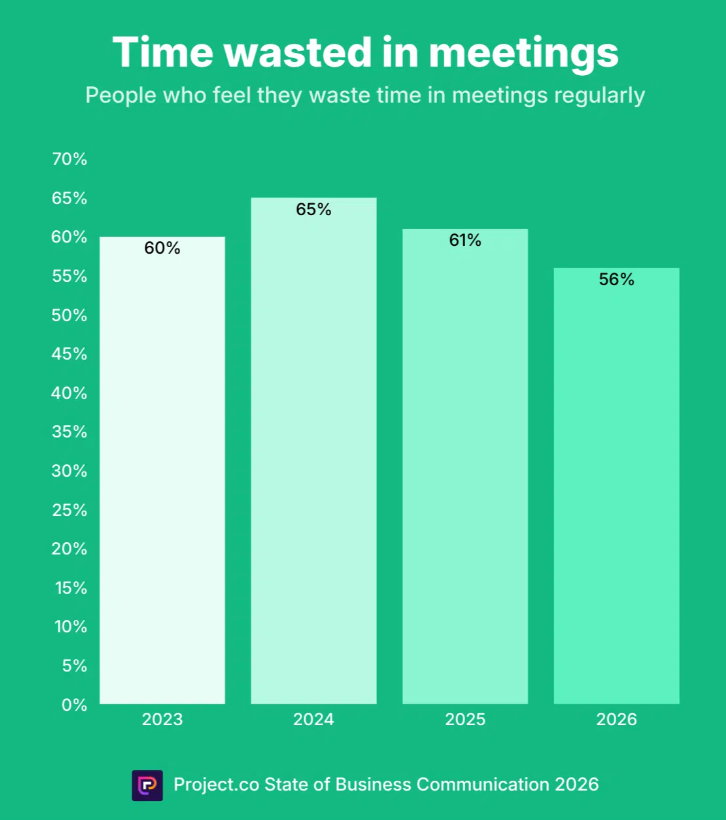
- 56% of people feel they waste time in meetings, a slight improvement on the year before, according to Project.co's 2026 communication statistics (opens in a new tab), based on a survey of 350 respondents.
- Despite the frustration, 81% of respondents in the Calendly survey said more meetings would actually help them in some way, showing how mixed employee sentiment really is.
- Remote workers feel more comfortable protecting their time than office-based colleagues: 75% of fully remote workers say it's appropriate to decline a meeting scheduled over another meeting, compared to 63% of fully onsite workers, per Calendly's report.
For teams trying to make sense of their own Zoom meeting analytics (opens in a new tab), these industry-wide patterns are a useful benchmark.
Pro tip: Tactiq (opens in a new tab) can do the same for your own Zoom calls, transcribing each meeting and summarizing it into notes and action items you can search later.
Want the convenience of AI summaries?
Try Tactiq for your upcoming meeting.
Zoom Growth & Historical Statistics
Zoom's rise from a niche tool to a fixture of modern work is one of the fastest adoption curves in software history. Virtual meetings went from a rare convenience to the default way many teams communicate in the space of a few months, and that shift still shapes how work happens today. The following historical figures come from Business of Apps' compiled Zoom data (opens in a new tab).
- Zoom grew from 10 million daily meeting participants in December 2019 to 300 million by April 2020, a surge of roughly 2,900% in under six months.
- Zoom last updated that figure in December 2020, reporting 350 million daily meeting participants, and has not published a refreshed number publicly since.
- Zoom's valuation exceeded $100 billion during the pandemic, a 383% increase on its value in January 2020.
- In 2021 alone, the Zoom mobile app was downloaded 485 million times, reflecting the scale of adoption during a period when average meeting duration also climbed alongside usage.
- App download volume has since cooled significantly from its 2020 peak, when Zoom recorded 740 million downloads in a single year, illustrating how much of that early surge was pandemic-driven rather than durable organic growth.
Zoom Meeting Fatigue & Productivity Statistics
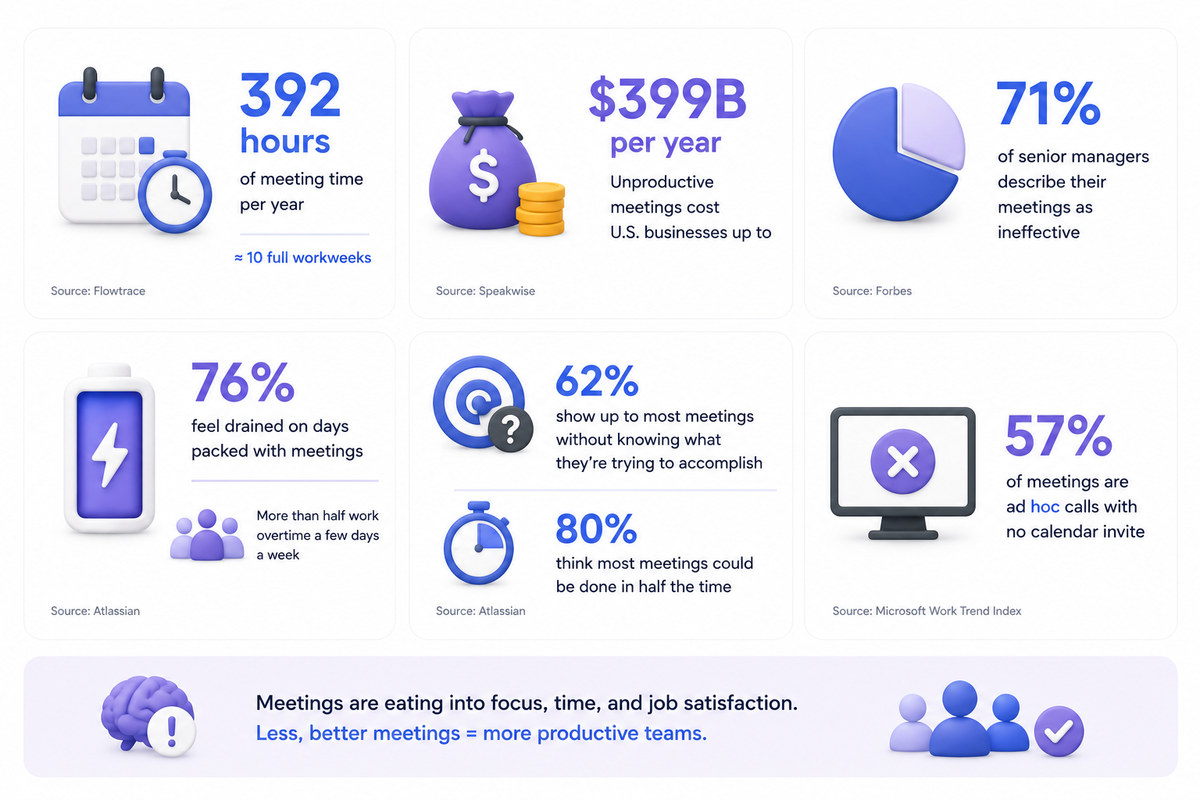
Virtual meetings have become the default way many teams collaborate, but workplace meetings in general still come with a real cost in focus, time, and job satisfaction.
- Employees spend an average of 392 hours of meeting time per year, roughly 10 full workweeks, according to Flowtrace's own analysis (opens in a new tab) of 1.3 million real meetings.
- Unproductive meetings cost U.S. businesses up to $399 billion per year, according to Speakwise (opens in a new tab).
- 71% of senior managers describe their meetings as ineffective meetings, calling them unproductive and inefficient, according to Forbes (opens in a new tab).
- 76% of respondents say they feel drained on days packed with meetings, and more than half work overtime a few days a week because meetings crowd out their actual work, per Atlassian's research on meeting overload (opens in a new tab).
- 62% of respondents say they show up to most meetings without knowing what they're trying to accomplish, and 80% think most of their meetings could be done in half the time, according to the same Atlassian survey.
- 57% of meetings are ad hoc calls with no calendar invite, making them difficult to track or improve, according to Microsoft's Work Trend Index (opens in a new tab).
What Zoom's 2026 Numbers Signal for Modern Work
Zoom's 2026 story is about durability, not explosive growth. Revenue crossed $4.87 billion, net income nearly doubled, and the company is guiding toward $5 billion in fiscal year 2027.
Meeting culture tells a messier story. Workers spend hundreds of hours a year in meetings, yet most still walk in without clear objectives and want their calendars back.
That tension will continue to shape how companies run meetings going forward, with more pressure for fewer meetings, shorter calls, clearer agendas, and greater value captured after the meeting ends
FAQ
Your questions, answered.
If you have any further questions, Get in touch (opens in a new tab) with our friendly team
How many people use Zoom in 2026?
What is Zoom's market share in 2026?
How many meeting minutes does Zoom host annually?
Is Zoom still growing in 2026?
How can I see my own team's Zoom meeting statistics?
Related articles

Zoom ChatGPT: How to Connect and Access Meetings

Zoom MCP: Features, Setup, and Limitations (Full Guide)

Zoom Workplace and Zoom Meetings Difference: What You Need to Know

What Is Zoom Cloud Meeting App?

Zoom Cloud Meetings for Mac: Full Guide

How to Edit Zoom Recording: A Complete Guide

How to Record Yourself on Zoom

How to Embed a Zoom Meeting on Your Website
Want the convenience of AI summaries?
Try Tactiq for your upcoming meeting.
Bringing AI into your meetings has never been so easy.
Add to Chrome - It's free!(opens in a new tab)Try Tactiq in your upcoming meeting!
Sign up now