
How to Use Apple Reactions in Google Meet
July 3, 2024
July 3, 2024
October 15, 2025
October 15, 2025

Google Meet now lets you react instantly with emojis that appear right on your video call. These in-meeting reactions make it easy to show feedback or emotion without saying a word.
While Apple Reactions once offered 3D effects on macOS Sonoma, most users now rely on Google Meet’s built-in emoji reactions for consistent results.
In this guide, you’ll learn:
- How to use emoji reactions
- How to turn reactions on or off in your meetings
- What to do when reactions don’t appear on your screen
Are Apple Reactions Still Available?

Apple Reactions are still built into macOS Sonoma, but these video effects were designed for video chat on FaceTime and other Apple devices, not for Google’s video calling app.
If you’re using a Mac, iPhone, or iPad, your device may still trigger reactions automatically when you make certain hand gestures in front of the camera. For example, a heart sign or the peace sign.
While some users may still see 3D animations like hearts or confetti, these Apple Reactions aren’t officially supported in Google Meet and often don’t respond consistently. If you want visual enhancements, try using Google Meet’s built-in video effects, such as background blur or lighting adjustments.
For better reliability, stick with Google Meet’s built-in emoji reactions in the video menu. They work across all devices (web, Android, and iOS) and won’t interfere with your video meetings.
What Are Reactions in Google Meet?
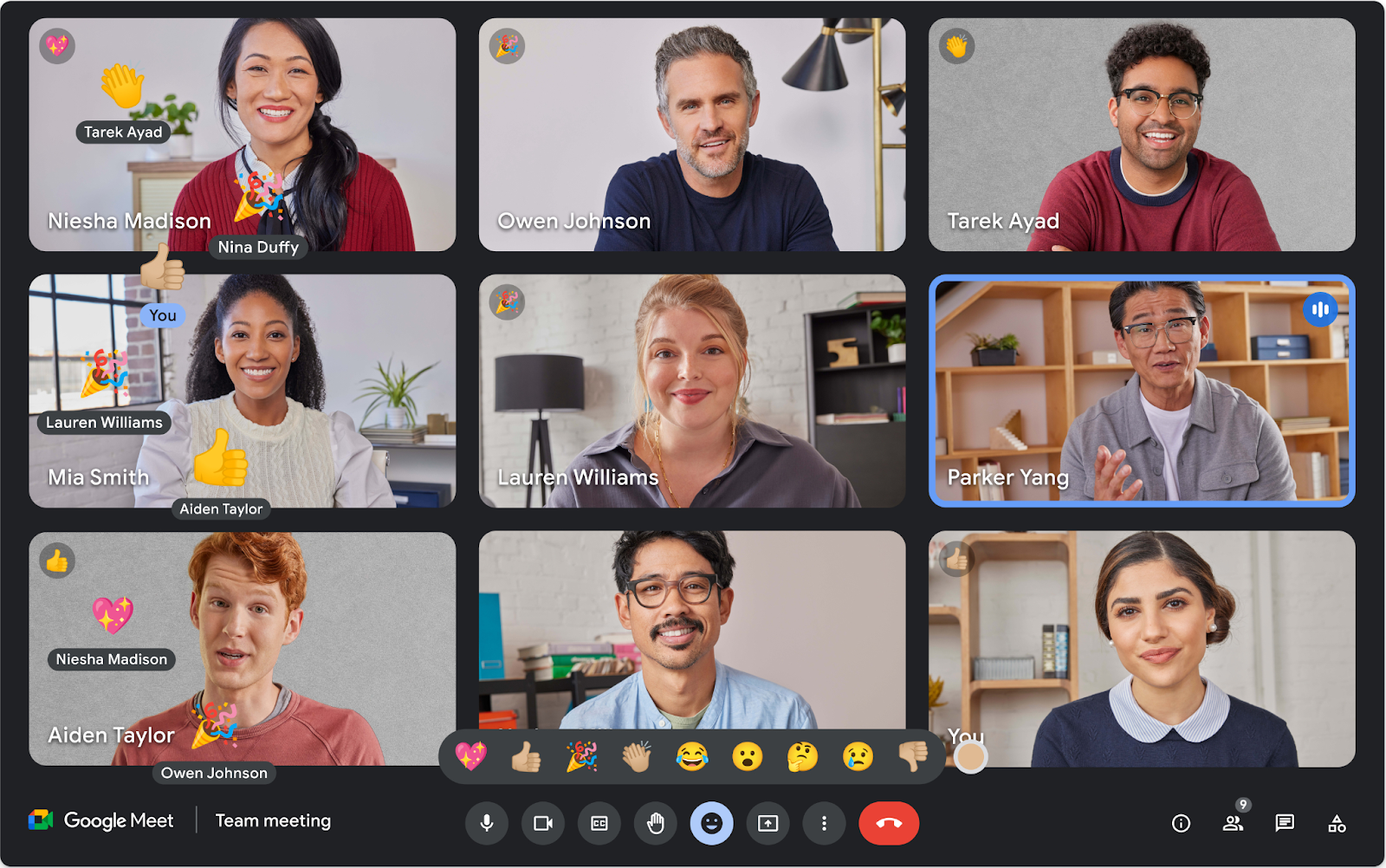
Image from Google
If Apple Reactions don’t work for you, Google Meet’s in-meeting reactions offer a simpler and more reliable way to share feedback during a video call. Instead of hand gestures or 3D effects, you can react instantly with emojis that appear right on the screen.
Each emoji briefly appears in the upper-left corner of your tile and floats up from the bottom of the video call window for everyone to see.
These reactions make it easier for meeting participants to show agreement, encouragement, or emotion in real time.
💡 Pro tip: React and stay engaged while Tactiq captures real-time transcripts and summaries from your Google Meet.
How to Use Reactions in Google Meet
You can share emoji reactions in Google Meet on Web, Android, or iOS during any video call. The process looks slightly different on each device, but the options are the same.
How to use reactions in Google Meet on desktop (web or Mac)
.png)
- Join your Google Meet.
- In the menu bar at the bottom, click the smiley icon to open the video menu.
- Select your reaction. Your emoji appears on your screen for everyone to see.
How to use reactions in Google Meet on mobile (iOS or Android)
.png)
- Join a video meeting in the Google Meet app.
- Tap the smiley icon in the control bar. (On some devices, this replaces the Raise hand button.)
- Choose your emoji reaction. You can also select the skin tone.
Reactions make live calls interactive, but automatic recording keeps the context clear. Read about Google Meet auto recording.
How to Turn Reactions On Or Off in Google Meet
Reactions are on by default in most Workspace and Enterprise accounts, but admins and hosts can turn them off at any time.
If reactions are disabled, the smiley icon still appears in the menu bar, but it can’t be clicked. When you hover over it, a message shows that reactions aren’t available.
To disable reactions for all participants:
- In your meeting window, go to the bottom right corner of the screen.
- Click Host controls.
- Under Meeting moderation, turn on Host management. You can also review who engaged during the meeting using your Google Meet attendance report.
- Toggle off Send reactions.
When Send reactions is off, no one in the meeting can use emoji reactions. You can re-enable them anytime by switching the toggle back on.
Admins can also manage this setting across all meetings under Admin control settings in the Google Workspace dashboard.
How To Customize Reactions In Google Meet
You can personalize how your emoji reactions look and sound during a video call. These options help you make reactions feel more natural and comfortable to use.
To adjust your settings:
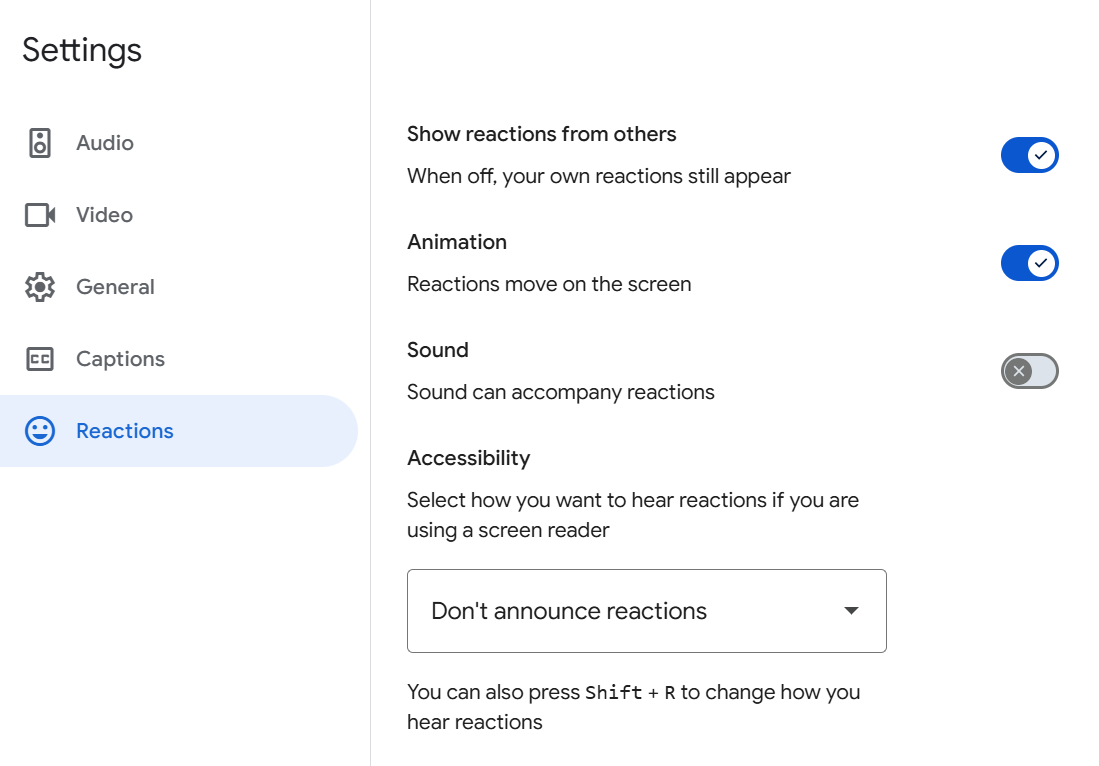
- Open the menu bar and click More options > Settings > Reactions.
- Turn each setting on or off based on your preference.
You can:
- Hide reactions from others during the meeting.
- Turn off animations if you prefer a calmer video call experience.
- Mute reaction sounds if they’re distracting.
These changes only affect your personal view, not other meeting participants.
At the moment, custom emoji sets aren’t supported in Google Meet. Users can’t upload or create their own icons yet, though many have requested this feature in the Google Help Community.
Common Issues and Fixes
If reactions don’t show during a video call, try these quick checks.
- Reactions disabled by host/admin - The smiley icon remains visible but isn’t clickable. When you hover over it, a message says reactions aren’t available. Ask the host to enable Send reactions in Host controls.
- Client-Side Encryption is on - Reactions aren’t available in Client-side Encrypted meetings. Join a standard meeting to use emoji reactions.
- Outdated app or browser - Update your Google Meet app or browser. Then rejoin the meeting. Check camera permissions in your system preferences if effects still don’t appear.
- Gesture reactions not working - Gesture-based Apple Reactions aren’t officially supported in Google Meet and may not respond. Use the built-in emoji reactions from the video menu instead.
Improve Your Google Meet Experience With Tactiq

With reactions enabled, you can make meetings more expressive, but keeping track of what’s said is just as important. Tactiq is a Chrome Extension that helps you capture every idea and turn your Google Meet into clear, actionable notes automatically.
Tactiq works directly inside your video call, so you can stay focused while AI handles the details. It also supports Zoom and Microsoft Teams, keeping all your video meetings organized in one place.
- In-Meeting AI: Ask AI questions in real time, like “What did we agree on?” or “Summarize the key points so far.”
- AI Workflow: Turn meeting insights into follow-up emails, project updates, or shared documentation instantly.
- Custom AI Prompts: Save your favorite prompts to find decisions, next steps, or discussion highlights faster.
- Search & Highlights: Locate quotes or keywords from past meetings without replaying recordings.
- Multi-language Support: Transcribe video calls in 60+ languages for global teams.
With Tactiq, your meetings stay focused, documented, and easy to act on.
Make your meetings smarter. Install the free Tactiq Chrome Extension and start turning every Google Meet, Zoom, and Teams call into instant AI-powered notes.
{{rt_cta_ai-convenience}}
Wrapping Up
Reactions make Google Meet more engaging, but it’s the insights you capture that make meetings meaningful. Many users now rely on Google Meet’s emoji reactions for quick, reliable feedback.
Combining these reactions with tools like Tactiq helps you go beyond expressions, turning every video call into organized, actionable outcomes. Try it today for free.
Want to add even more personality to your calls? Check out these funny Google Meet backgrounds for your next meeting.
FAQs About Reactions in Google Meet
How do I use reactions in Google Meet?
Click the smiley icon in the menu bar during your video call, then choose from hearts, claps, smiles, thumbs up, or thumbs down.
Why don’t Apple Reactions work in Google Meet?
Apple Reactions only work reliably in Apple apps like FaceTime. In Google Meet, use built-in emoji reactions instead.
Can I customize emoji reactions in Google Meet?
Yes. Go to More > Settings > Reactions to change preferences.
Why can’t I see reactions in my meeting?
Reactions may be turned off by your host or admin, or unavailable in Client-side Encrypted meetings.
Are reactions available in encrypted meetings?
No. Reactions aren’t supported in Client-side Encrypted meetings for privacy reasons. Learn more about Google Meet encryption.
Apple Reactions are dynamic video effects that appear in your frame during a Google Meet call, triggered by specific hand gestures or selected from the menu. They let you express emotions visually, so you can give feedback or show appreciation without interrupting the speaker, making meetings more interactive and engaging.
Apple Reactions are enabled by default for Workspace and Enterprise accounts unless turned off by an admin or host. To disable them for everyone, go to 'Host controls,' turn on 'Host management,' and switch off the 'Send reactions' toggle—this prevents participants from using reactions in the current meeting.
You can personalize Apple Reactions by going to 'More options,' then 'Settings,' and selecting 'Reactions.' Here, you can choose to see reactions from others, enable or disable animations and notification sounds, and set your preferred emoji skin tone, creating a meeting environment that matches your style.
Check that your device is compatible and running the latest software, and ensure reactions are enabled in your meeting settings. If you’re using a Workspace or Enterprise account, the admin or host may have disabled reactions, so you may need to contact them or adjust your own settings to resolve the issue.
You can trigger reactions by making specific hand gestures, such as a heart sign for hearts, a peace sign for balloons, or thumbs up for fireworks. If you prefer not to use gestures, simply click 'Reactions' in the menu and select your desired effect, allowing you to express yourself in the way that feels most natural.
Related articles


_Main.jpg)




Want the convenience of AI summaries?
Try Tactiq for your upcoming meeting.
Want the convenience of AI summaries?
Try Tactiq for your upcoming meeting.
Want the convenience of AI summaries?
Try Tactiq for your upcoming meeting.