
How to Use AI for Product Research
- Published:
- March 11, 2025
- Updated:
- August 27, 2026

Product research isn’t what it used to be. More than a decade ago, teams relied on surveys, focus groups, and historical sales data to understand customer needs. While these methods still have value, AI has changed the game. Now, businesses can analyze data from online reviews, social media, and customer interactions in real time—discovering insights that were once impossible to gather at scale.
But while AI adoption is growing, 74% of companies (opens in a new tab) struggle to achieve and scale value from their AI initiatives. With so many AI research tools available, how do you make them work for your research process?
In this guide, we’ll break down the challenges of product research, show you how AI fits into the process, and explore the best tools to help you make data-driven decisions.
What is AI in Product Research?
AI in product research refers to the use of AI tools and algorithms to analyze the following areas for product development:
- Market trends
- Customer feedback
- Competitor data
AI speeds up this research process by automating data collection, identifying patterns in online reviews, and even predicting future trends based on real-time insights.
AI-powered product research tools use natural language processing (NLP) to analyze unstructured feedback, machine learning to detect buying patterns, and predictive analytics to forecast demand.
Challenges in Product Research
Understanding what customers want is never straightforward. Even with access to market research reports and customer feedback, businesses still struggle to extract actionable insights that shape product development. Here are some common hurdles:
- Information Overload - Companies collect massive amounts of data, but sorting through it manually is time-consuming. Data professionals report an average monthly data volume growth of 63% (opens in a new tab) within their organizations. Without AI tools, important patterns and trends can go unnoticed.
- Unstructured Feedback - Customer feedback comes from various sources, such as online reviews, surveys, and social media. Understanding all this unstructured data requires advanced natural language processing techniques.
- Rapid Market Changes - Consumer preferences and market trends shift quickly. Traditional research methods may not capture real-time shifts and could lead to outdated strategies. Industries like fashion and tech experience rapid changes, with brands like Zara (opens in a new tab) using AI to analyze real-time sales data and adjust designs, while Apple (opens in a new tab) uses AI to predict product demand and optimize development.
- Bias in Research - Teams may unintentionally focus on the wrong data points or rely too much on historical sales data, thereby missing new opportunities.
- Limited Resources - Smaller teams or startups may not have dedicated product researchers. This makes it harder to conduct thorough data analysis and competitive benchmarking.
5 Ways to Use AI for Product Research
The challenges of product research make it difficult for businesses to keep up with shifting customer needs. But AI is changing that. Here’s how you can use AI to help you develop better products.
1. Automating Data Collection and Analysis
As mentioned earlier, traditional product research requires gathering information from multiple sources, such as customer reviews, surveys, and market reports. This process is labor-intensive and prone to errors.
AI tools automate data collection from structured and unstructured sources to reduce the workload and improve accuracy. In addition to data analysis, businesses are increasingly adopting customer service automation (opens in a new tab) to handle inquiries and gather feedback more efficiently, feeding valuable insights directly into product development. Advanced algorithms can analyze data in real time and identify hidden patterns and trends that would be difficult to detect manually.
For example, Levi Strauss & Co. (opens in a new tab) uses AI-powered analytics to process millions of consumer demand signals to optimize their product offerings based on regional preferences.
2. Sentiment Analysis for Customer Insights
AI sentiment analysis tools (opens in a new tab) evaluate online reviews, social media conversations, and survey responses to determine how customers feel about products. This allows businesses to pinpoint strengths, identify pain points, and adjust strategies based on real customer feedback rather than guesswork.
For example, Wayfair (opens in a new tab) uses AI tools to generate personalized product recommendations based on design preferences.
3. Predictive Analytics for Market Trends

General Electric uses AI for manufacturing purposes (opens in a new tab)
AI can forecast market trends by examining historical sales data and current consumer behavior. Using predictive analytics, businesses can anticipate product demand, optimize inventory levels, and adjust marketing campaigns accordingly. Instead of reacting to shifts in the market, AI allows companies to stay ahead of the curve and make proactive decisions.
For example, General Electric (GE) (opens in a new tab) applies AI in manufacturing to predict market demands, optimize production, and reduce equipment failures with proactive insights.
4. Personalization for Product Development
AI enables businesses to create personalized experiences by analyzing customer preferences and behaviors. With AI product research (opens in a new tab), companies can develop products that align more closely with specific customer needs. AI-driven personalization is also used in recommendation engines and AI shopping assistants (opens in a new tab) to allow brands to offer tailored product suggestions that improve customer satisfaction and retention.
For example, Coca-Cola (opens in a new tab) used AI to develop a new beverage flavor based on customer feedback, tailoring its product to align with evolving consumer tastes.
5. AI-Driven Competitor Analysis
AI can track competitors’ product launches, pricing strategies, and customer feedback in real time. This information can help businesses identify market trends, evaluate approaches such as good-better-best pricing (opens in a new tab), and make more informed decisions when refining their own product strategies. Using competitor pricing intelligence (opens in a new tab), teams can monitor pricing pages, promotions, packaging changes, feature tiers, and stock availability to make more informed decisions. By using AI data analysis (opens in a new tab), businesses can assess their competitive position, identify gaps in the market, and differentiate their offerings. Instead of manually scanning competitor websites and reports, AI tools aggregate this information and provide valuable insights at scale. This approach is similar to web scraping (opens in a new tab), where large amounts of public data are collected and analyzed. It may also be used to extract Google data (opens in a new tab) to better understand trends, visibility, and competitor positioning.
Top AI Tools for Product Research
Now that you know how AI enhances product research, the next step is choosing the right tools. Here are some of the best AI tools to take your research process to the next level.
1. Tactiq: AI Meeting Insights for Product Teams
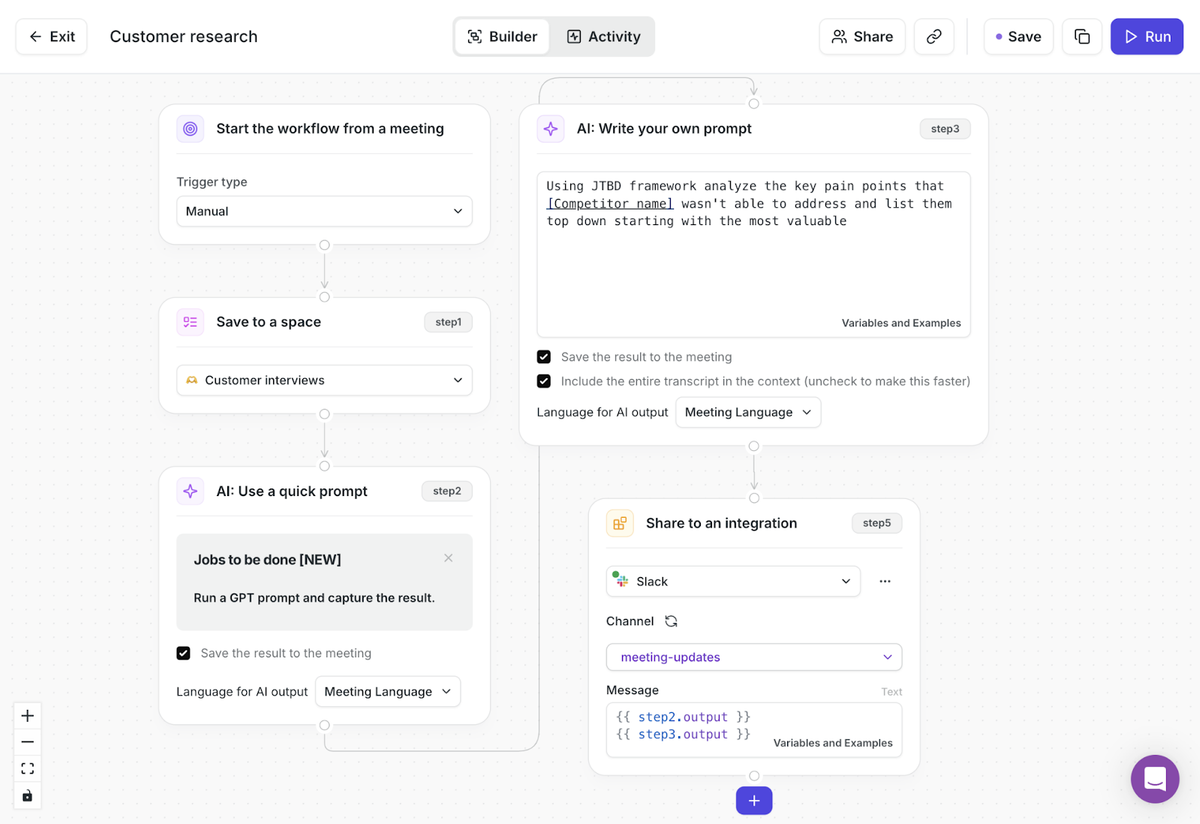
Tactiq (opens in a new tab) ensures you don’t miss key insights from research discussions, stakeholder meetings, and customer interviews. By transcribing, summarizing, and organizing virtual meetings from Zoom, Google Meet, and MS Teams, Tactiq helps teams make better decisions without the hassle of manual note-taking.
Key Features:
- Transcribe every discussion with accuracy (opens in a new tab) – Capture insights from product stand-ups, roadmap reviews, and customer feedback sessions.
- Generate AI-powered summaries – Quickly extract action items, decisions, and research takeaways with custom AI prompts.
- Keep stakeholders aligned – Create digestible meeting updates for Slack, email, or Notion to keep teams informed.
- Streamline product workflows (opens in a new tab) – Automate Jira and Linear (opens in a new tab) ticket creation from meeting insights to speed up backlog grooming.
- Jobs-to-Be-Done (JTBD) Prompt – A pre-made AI Workflow (opens in a new tab) prompt designed to uncover users' core needs in one click to help product and marketing teams refine messaging, sales materials, and customer support content.
Tactiq is ideal for product managers (opens in a new tab), UX researchers, and stakeholder teams who need to capture and organize meeting insights. Download the free Tactiq Chrome Extension today! (opens in a new tab)
2. Eliotron: AI Product Research & Sourcing

Eliotron (opens in a new tab) is a product research tool that helps businesses discover trending products, analyze market demand, and connect with reliable suppliers. It streamlines the research process by analyzing historical sales data, customer trends, and competitor insights to identify high-potential products before they saturate the market.
Key Features:
- AI Product Discovery – Finds trending products by analyzing market trends and demand fluctuations.
- Competitor Insights – Tracks competitor pricing, product launches, and consumer engagement.
- Smart Supplier Lookup – Connects users with suppliers from platforms like Alibaba, AliExpress, and Walmart to make it easier to source products at competitive prices.
- Data-Driven Validation – Uses AI to filter through thousands of products to ensure businesses invest in items with proven demand and profit potential.
Eliotron is ideal for eCommerce sellers, product managers, and businesses looking to stay ahead in competitive markets.
3. Crayon: AI Competitive Intelligence
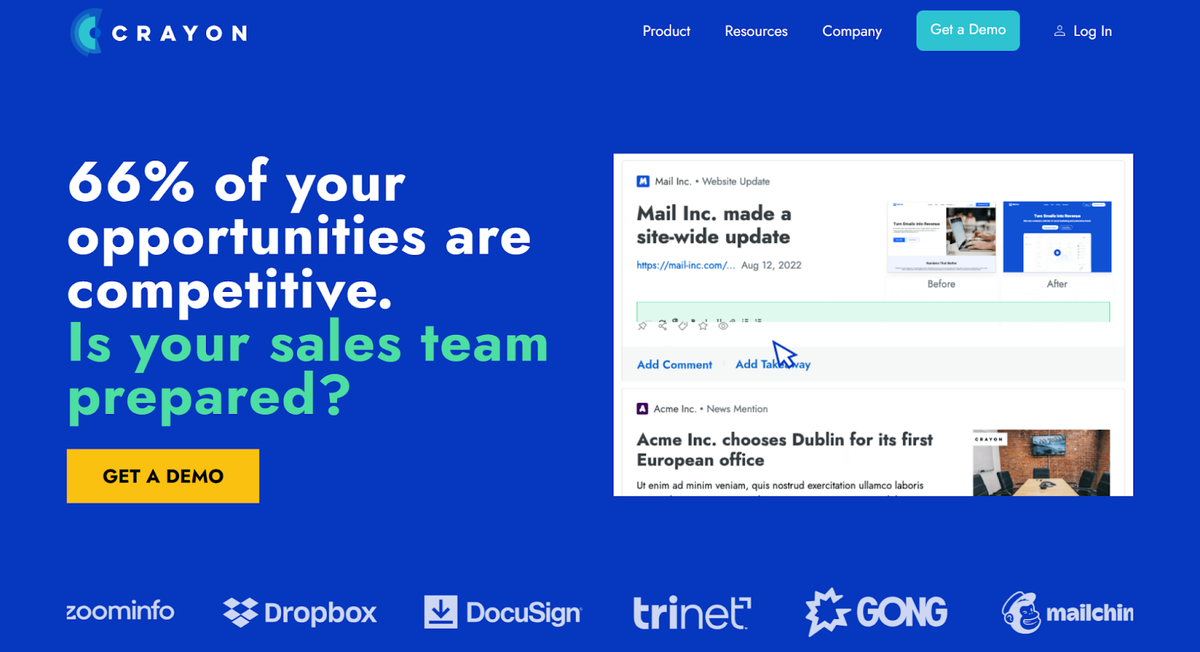
Crayon (opens in a new tab) is a competitive intelligence tool that helps businesses monitor their competitors in real time. Instead of manually tracking product launches, pricing changes, or customer sentiment, Crayon automates data collection from thousands of sources, including company websites, social media, and online reviews.
Key Features:
- Competitor Tracking – Monitors pricing, product updates, and customer reactions to competitor offerings.
- Market Trends Analysis – Detects shifts in market trends, helping businesses adjust strategies proactively.
- Automated Reports – Delivers digestible updates around competitor activities and reduces manual research time.
- Sales Enablement Insights – Equips sales teams with real-time data to refine their approach based on competitive positioning.
Crayon is perfect for product managers, marketing teams, and sales strategists who need real-time insights on competitors.
4. Hotjar: AI User Behavior Analytics
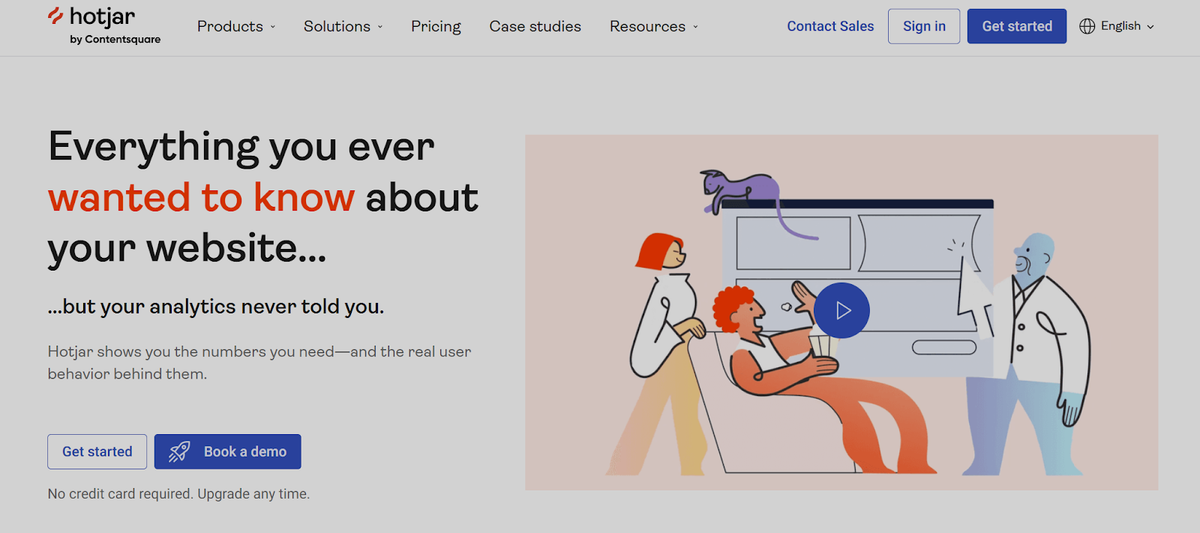
Hotjar (opens in a new tab)is a user behavior analytics tool that helps businesses understand how customers interact with their websites and digital products. By providing heatmaps, session recordings, and survey insights, Hotjar allows teams to see where users engage, struggle, or drop off. This helps product teams refine features, improve UX, and optimize conversion rates.
Key Features:
- Heatmaps – Visualize where users click, scroll, or abandon a page.
- Session Recordings – Replay user interactions to identify pain points and usability issues.
- User Feedback & Surveys – Collect direct customer insights (opens in a new tab) to improve product features.
- AI-Driven Insights – Detects patterns in behavior and suggests optimizations to improve user experience.
Hotjar is perfect for product managers, UX designers, and growth teams looking to improve customer experience (opens in a new tab) and optimize digital products.
5. Perplexity: AI Research Assistant

Perplexity (opens in a new tab) is an answer engine that provides real-time, data-driven insights by aggregating and verifying information from multiple sources. Unlike traditional search engines, Perplexity delivers concise, fact-checked responses with citations.
Key Features:
- AI-Powered Market Research – Quickly gathers insights on market trends, competitor analysis, and consumer behavior.
- Real-Time Data Aggregation – Sources the latest information across verified databases, reducing time spent on manual research.
- Buy with Pro – An AI shopping assistant that allows users to research and purchase products directly through the platform.
- Fact-Checked Answers – Provides research-backed responses with source attributions, making it ideal for product teams that require reliable data.
Perplexity is a great tool for product managers, market researchers, and business strategists looking for fast, accurate insights.
6. Intercom – AI-Powered Customer Support & Product Research
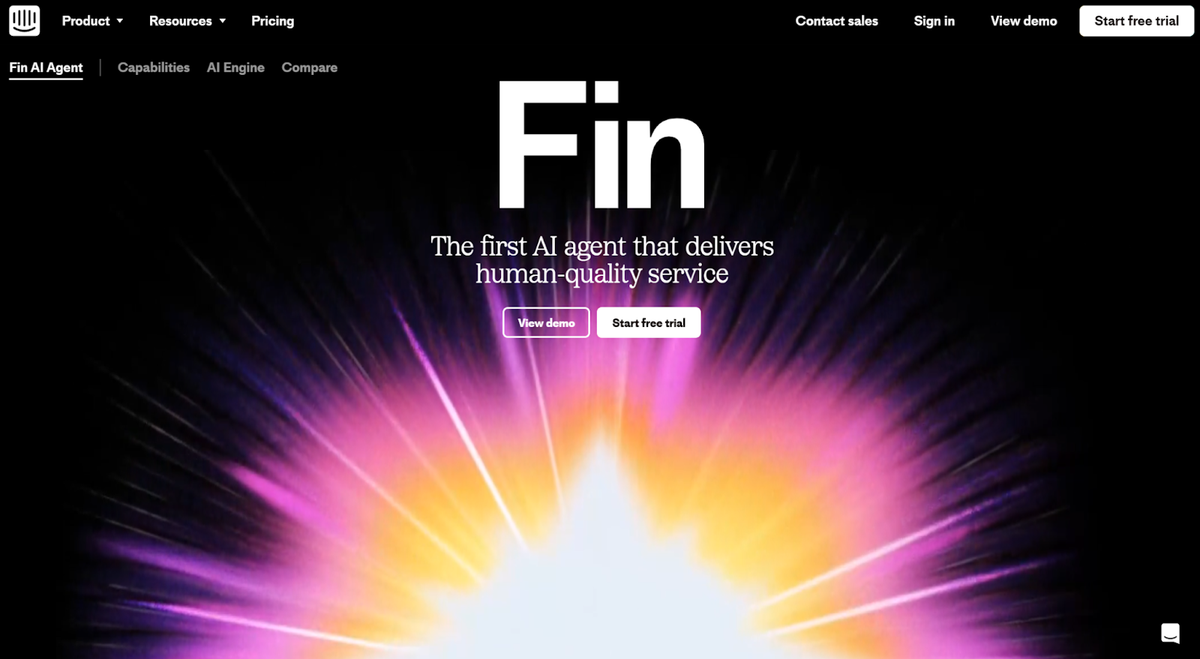
Intercom (opens in a new tab) enhances customer support and product development through AI-driven automation and advanced language models. Its chatbot, Fin, can handle complex queries, clarify customer concerns, and engage in full conversations.
Key Features:
- AI Chatbots for Customer Support – Automates responses, reducing support workload while maintaining personalized interactions.
- AI-Driven Product Insights – Analyzes user interactions to help businesses refine product development and optimize user experience.
- Seamless AI Integration – Embeds AI at every stage of product design for intuitive user experiences.
Intercom is perfect for customer support teams, product managers, and UX designers looking to use AI for automated support and product research.
Wrapping Up
AI has made product research faster, more accurate, and more insightful. With AI, you can simplify your research process and stay ahead of industry shifts. By integrating the right tools, your team can develop smarter strategies, refine your offerings, and deliver products that truly meet customer needs.
FAQ
Your questions, answered.
If you have any further questions, Get in touch (opens in a new tab) with our friendly team
How to use AI to do product research?
How does AI affect product research?
What’s the best AI tool for product research?
Can AI replace traditional product research methods?
How do businesses use AI for competitor analysis?
Related articles

Gemini 3.5 Transcribe: Google Transcript Model Explained
Context Engineering vs Prompt Engineering: What Your AI Agents Are Missing

Claude Memory: How to Import and Manage Your AI Context

Claude Cowork Connectors: Automate Recurring Work

Google Gemini MCP Support: Where It Works and Setup Tips

Best Claude Skills: Top Picks for Meetings, Content, and Code

5 Best AI Scheduling Assistants

Microsoft Teams MCP: How to Access Meeting Content With AI
Want the convenience of AI summaries?
Try Tactiq for your upcoming meeting.
Bringing AI into your meetings has never been so easy.
Add to Chrome - It's free!(opens in a new tab)Try Tactiq in your upcoming meeting!
Sign up now