
What Are Meeting Notes? How to Use Them Right
- Published:
- May 16, 2025
- Updated:
- June 16, 2025

Ever finish an entire meeting only to realize you forgot who’s doing what and by when? Good meeting notes keep everyone aligned and clearly capture key points and next steps. However, many teams confuse meeting notes with formal minutes or struggle to make them useful for future reference.
In this guide, you’ll learn what meeting notes are, how they're different from official documentation, and some easy ways to improve your note-taking process.
What Are Meeting Notes?
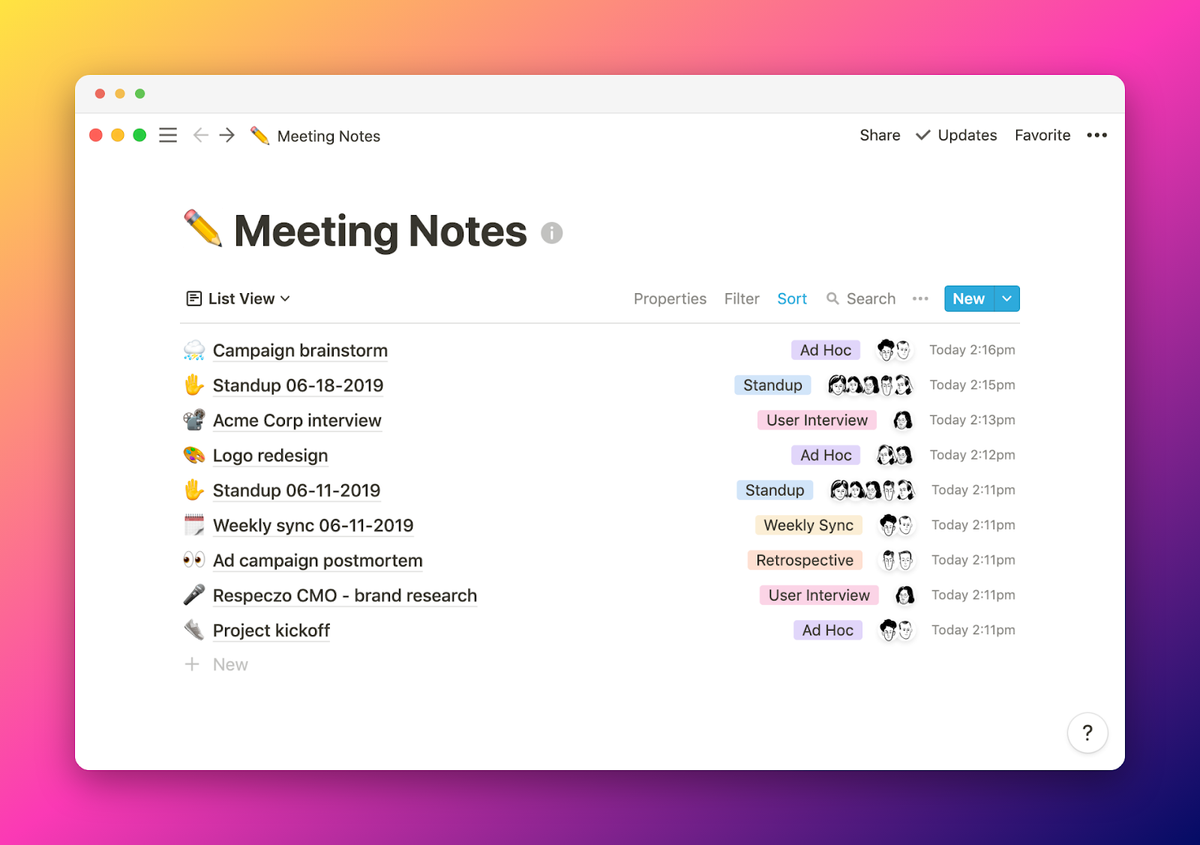
Meeting notes are practical summaries that capture the key points and important details of a meeting. They help keep everyone on the same page about decisions, discussions, and action items. Unlike legal or formal documents, meeting notes serve as an informal, easy-to-reference snapshot of what happened—ideal for quick check-ins or recurring meetings.
Usually, one designated note-taker handles writing meeting notes during or immediately after the session. This could be the meeting organizer or any other team member comfortable with taking notes. The notes are then shared promptly with all meeting participants, so everyone can stay informed and accountable.
Meeting Notes vs Minutes: What’s the Difference?
Teams often mix up what meeting minutes and notes are, but each serves a distinct purpose. Unlike meeting notes, meeting minutes are a formal record, capturing detailed discussions for business meetings or critical company decisions. They're structured, archived, and sometimes treated as official documentation or even a legal document.
On the flip side, meeting notes are informal and practical. They aren’t usually archived formally, nor do they serve as an official record. When comparing minutes vs notes, the key difference lies in formality, detail level, and how the information is used later.
If you're handling high-stakes or regulated discussions, minutes are necessary. But if you need something quick and clear for your team's daily workflows, meeting notes are the way to go.
How to Take Meeting Notes Effectively
Let’s break down how to make your note-taking more effective.
Manual vs AI note-taking
There are two main ways teams handle notes today: manual and AI-powered.
Manual note-taking means someone records key points by hand or types them directly into a document during the meeting. It requires strong note-taking skills and good focus. The upside? You control exactly what's captured. The downside? It can be distracting and easy to miss details.
An AI note-taking tool automatically transcribes conversations and highlights action items. This lets your team stay focused on the discussion without missing critical points.
What to include in meeting notes
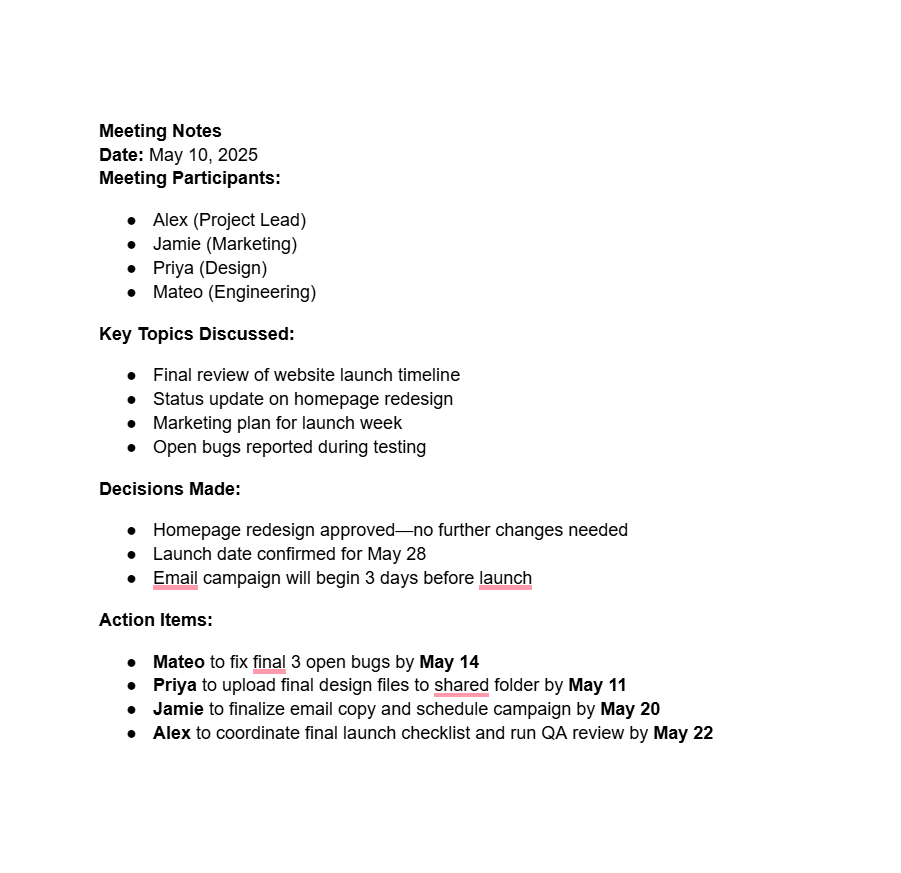
Effective meeting notes should be clear, focused, and cover the right information. They should reflect the flow of the conversation, often guided by the meeting agenda. Make sure to include these key elements:
- Date & meeting attendees
- Always record the meeting date and list all meeting participants. This gives context for future reference and makes it easy to track who was involved in the conversation. It’s especially helpful for recurring meetings or when following up later.
- Key topics discussed
- Summarize the main discussion points without writing everything word for word. Use short phrases or bullet points to capture the heart of each topic. This helps the team stay aligned and quickly revisit the discussion if needed.
- Decisions made
- Documenting decisions is crucial. These are the outcomes that move projects forward. Whether it’s choosing a vendor, updating a timeline, or approving a proposal, noting decisions gives everyone a shared understanding of what’s been agreed upon.
- Action items with owners and due dates
- One of the most valuable parts of writing great meeting notes is assigning clear next steps. Each action item should include what needs to be done, the person responsible, and when it’s due. This accountability helps teams follow through.
Together, these elements make your notes a practical piece of meeting documentation—not just a record of what was said, but a tool to guide what happens next.
Best practices for clean notes
Even the best information can get lost if it’s buried in long paragraphs or scattered details. Use these tips to keep your notes easy to read and act on:
- Use bullet points: Lists make it easier to scan for key points and avoid long blocks of text.
- Keep it simple: Don’t try to capture every word. Focus on important details, outcomes, and responsibilities. Short, direct sentences work best.
- Take notes in real time or right after the meeting: The sooner you write them, the fresher the information. If you wait too long, small but critical points might be forgotten.
- Share notes promptly: Send notes soon after the meeting so team members can take action before the next meeting. Late notes often get ignored or buried in inboxes.
Good meeting notes don’t need to be perfect; they just need to be useful. The goal is to create a shared reference point that’s clear, actionable, and easy for everyone to understand. When you focus on clarity over detail, your team will actually use the notes, and that’s what makes them effective.
How Tactiq Makes Note-Taking Smarter
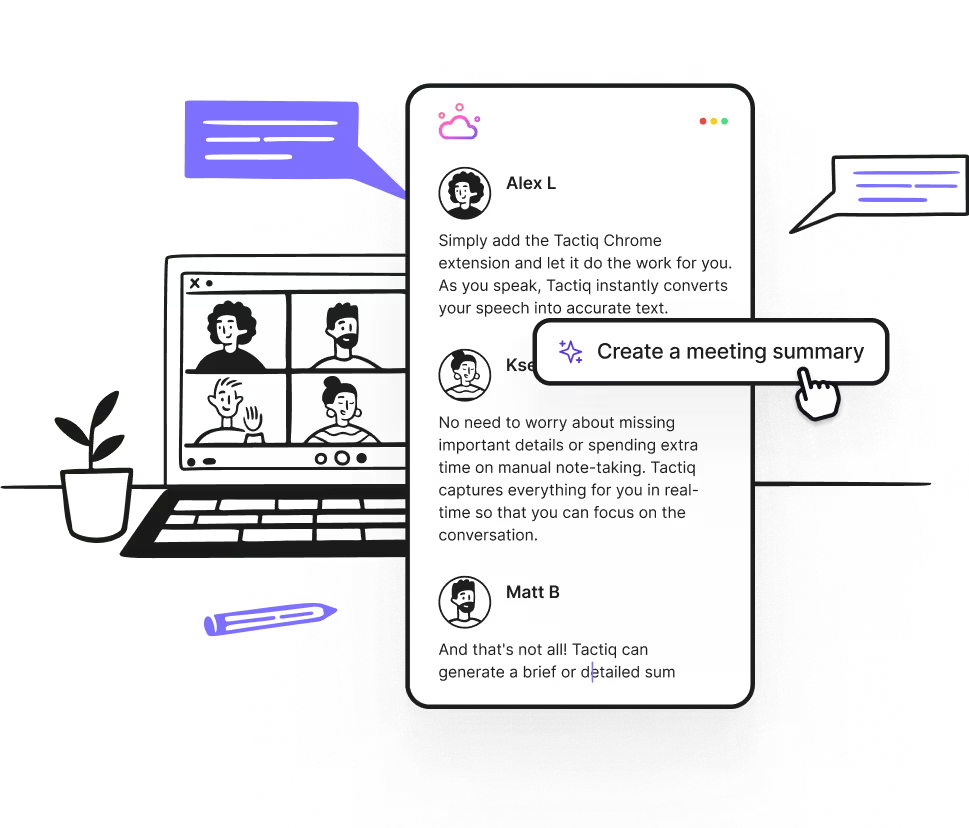
If you already use AI for note-taking, you know how helpful it can be during fast-paced meetings. Tactiq (opens in a new tab) is an AI tool that captures conversations during virtual meetings, pulls out action items and decisions, and makes it easier to keep track of what your team discussed without losing focus during the call.
- Transcribe and summarize in real-time.
- Tactiq provides live transcription and summaries during meetings on Microsoft Teams, Google Meet, and Zoom so you can stay engaged without writing everything down.
- Pull action items and decisions with prompts.
- Easily highlight key points, decisions, and tasks by asking Tactiq AI custom prompts. No more digging through lengthy notes afterward.
- Search notes by keyword or speaker.
- Quickly find past conversations or details just by typing in keywords or a team member's name.
- Integrate with other tools like Notion.
- Sync meeting notes automatically with your favorite productivity apps, keeping all your team's notes and tasks organized in one place.
Ready to write AI meeting notes? Download the free Tactiq Chrome Extension (opens in a new tab) today for more productive meetings!
Want the convenience of AI summaries?
Try Tactiq for your upcoming meeting.
Wrapping Up
Meeting notes are essential for capturing important discussions, clarifying decisions, and keeping your team aligned between meetings. Whether you're jotting them down manually or using AI to lighten the load, good meeting notes turn conversations into action.
Want to make note-taking easier for your next meeting? Try Tactiq for free (opens in a new tab) and let AI do the heavy lifting.
FAQ
Your questions, answered.
If you have any further questions, Get in touch (opens in a new tab) with our friendly team
What are meeting notes?
How are meeting notes different from minutes?
What are the benefits of meeting notes?
What is another name for meeting notes?
What is a meeting note summary?
Related articles

Best Practices for Using MCPs with Your Meeting Notes

Questions to Ask Higher Management During Meetings

How to Use Google Docs for Meeting Minutes

25 Funny Questions to Ask During a Staff Meeting (with AI)

How to See Who Accepted a Meeting in Outlook

How to Reschedule a Meeting in Outlook

Best Way to Schedule a Meeting with Multiple Attendees

How to Use ChatGPT Record Mode to Get Meeting Transcripts
Want the convenience of AI summaries?
Try Tactiq for your upcoming meeting.
Bringing AI into your meetings has never been so easy.
Add to Chrome - It's free!(opens in a new tab)Try Tactiq in your upcoming meeting!
Sign up now