
ChatGPT for Job Interviews: Unlocking Career Success
July 8, 2023
July 8, 2023
January 11, 2026
January 11, 2026

Job interviews take time and focus. Preparation often decides the outcome, especially in a competitive job market where small details matter.
ChatGPT now works as a flexible career coach that supports career guidance across different career paths, similar to how a career counselor helps structure decisions and next steps. Many now use it as part of their job search strategy.
ChatGPT has become more useful for interview practice. New models handle longer context, voice features support spoken answers, and memory helps refine responses over time. Together, these tools support stronger interview skills.
In this guide, you’ll learn:
- How ChatGPT works as a career coach
- Ways job seekers use AI tools for interview preparation
- How to practice for a job interview using structured prompts
- Where ChatGPT fits and where it falls short
- How AI tools help you review real interview conversations
ChatGPT Career Coach: How to Use It for Career Development
ChatGPT now functions as a flexible career coach, guiding diverse career paths. With newer models like GPT-4o, GPT-4 Turbo, and GPT-5, it can process longer context, remember past inputs, and respond in more useful ways. When voice and web access are enabled, it also supports deeper exploration and follow-ups.
Used well, ChatGPT becomes a valuable resource for planning your professional life. It helps job seekers think through decisions, test ideas, and prepare for real job opportunities.
Below are practical ways to use it.
Analyze job descriptions and role fit
Job descriptions often don’t disclose what hiring managers care about most. ChatGPT can break them down and surface priorities.
You can paste a job description and ask ChatGPT to:
- Identify critical requirements and soft skills
- Flag transferable skills from your work history
- Map your experience to a relevant job title
Sample prompt:

“Analyze this job description and tell me which qualifications matter most. Then suggest how I should highlight them during the interview process.”
This helps job seekers focus their preparation and avoid generic answers.
Improve resume writing and cover letters
Resume writing still plays a determining role in job applications. ChatGPT can review resumes, suggest structure changes, and tailor content for specific job openings.
You can ask it to:
- Rewrite bullet points for clarity and impact
- Adapt resumes for a job title in a new industry
- Draft a targeted cover letter for a specific role
Sample prompt:
“Review my resume for this job opening and suggest edits that better match the role and company culture.”
Always review suggestions carefully. ChatGPT provides direction, not final judgment.
Identify skills gaps and learning paths
Career growth often depends on knowing what to learn next. ChatGPT helps job seekers run their own research and assess gaps.
You can use it to:
- Compare your skills to market expectations
- Identify hard skills and soft skills to improve
- Build a short learning plan for an upcoming interview
Sample prompt:
“Based on this job description and my resume, identify skill gaps and suggest a realistic learning plan over the next 30 days.”
This supports informed decisions instead of guesswork.
Pro tip: Some job seekers connect Google Drive to ChatGPT so it can reference resumes, past projects, or notes during analysis.
Prepare smarter job search strategies
ChatGPT also supports broader job search planning. It helps job seekers think through job search strategies, track job openings, and explore new career paths.
You can ask it to:
- Suggest job search strategies by industry
- Compare roles across the job market
- Draft follow-up email templates after interviews
Used consistently, ChatGPT provides valuable insights that help job seekers stay up to date and focused.
That said, ChatGPT works best as a support tool. It offers immediate feedback and structure, but it does not replace human career coaches or real interview data.
Can You Use ChatGPT for Job Interviews?
ChatGPT supports interview preparation when used with a clear structure. It helps job seekers practice answers, improve interview skills, and prepare for a potential interview across roles and industries.
Recent updates expand how ChatGPT fits into interview coaching. Features like voice mode, conversation memory, and ChatGPT record mode support reflection and follow-up after practice sessions.
Used consistently, this approach helps job seekers move toward becoming confident and successful interviewees.
Use role-specific mock interview frameworks
ChatGPT can act as a coach for different interview formats, including behavioral, technical, and case interviews. You can tailor questions to a relevant job title, seniority level, or company culture.
Example prompt:
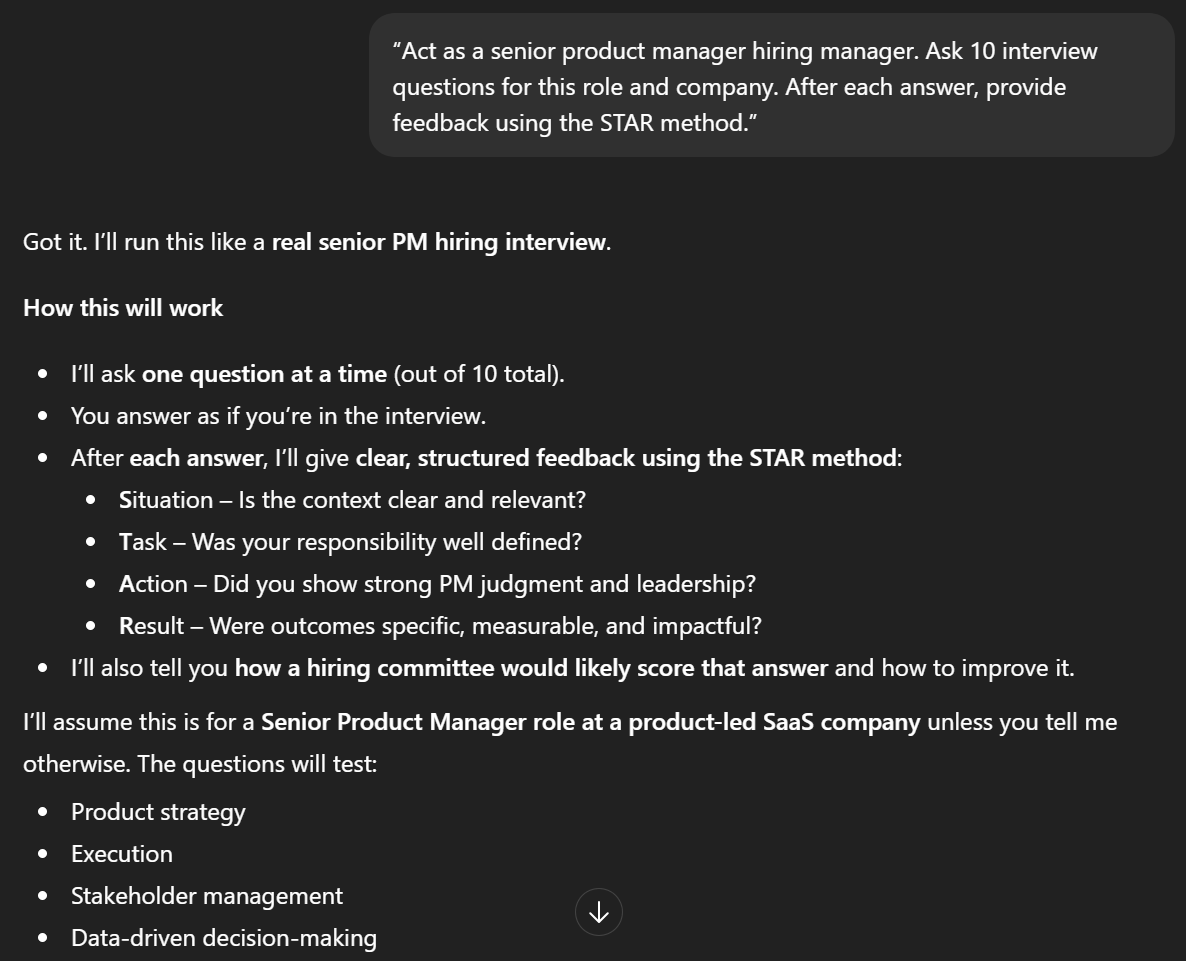
“Act as a senior product manager hiring manager. Ask 10 interview questions for this role and company. After each answer, provide feedback using the STAR method.”
This mirrors how hiring managers evaluate candidates and helps job seekers practice realistic scenarios.
Follow a structured interview practice workflow
A repeatable workflow keeps interview preparation focused.
Step 1: Generate tailored interview questions
Ask ChatGPT to create questions based on the job description and role expectations.
Step 2: Practice and refine answers
Answer questions using text or voice mode. Conversation memory allows ChatGPT to refine responses across sessions.
Step 3: Ask for feedback and scoring
Request structured feedback using STAR or similar frameworks to identify strengths and gaps.
Example prompt:
“Score my answers from this mock interview and suggest specific improvements.”
Pro tip: If you want to keep a record of your mock interviews or feedback, you can also export ChatGPT conversations and review them later.
Practice spoken answers with voice mode

ChatGPT’s voice mode supports spoken interview practice. This helps job seekers focus on clarity, pacing, and communication abilities rather than written responses.
You can practice answers out loud, get immediate feedback, and refine responses using conversation memory. This approach reflects the real interview process more closely.
Where ChatGPT record mode fits
ChatGPT record mode is available in the ChatGPT macOS app for Team users. It records audio and generates structured summaries with key points and action items after the session ends.
This feature works well for:
- Capturing mock interview practice
- Reviewing solo preparation sessions
- Summarizing reflections after interviews
It does not provide live transcription, speaker identification, or interview-grade records. It’s best used as a reflection tool rather than a full interview review solution.
💡 Pro Tip: ChatGPT helps you practice, but Tactiq captures what actually happens in real interviews. Get accurate transcripts of your Zoom, Google Meet, or Teams interviews to review later.
Know the limits and verify information
ChatGPT is an AI model. It can generate confident responses that include assumptions or inaccuracies.
Best practices:
- Verify factual details
- Double-check company-specific information
- Use ChatGPT for preparation, not final decisions
For real interviews, pairing practice tools with accurate transcripts becomes important.
How to Review Your Interview Transcript Using Tactiq
Practicing with ChatGPT helps you prepare for interviews. Reviewing what actually happened can help you improve. That’s the difference interview transcripts make.
Tactiq captures live interview conversations and turns them into accurate transcripts you can review later. It works with Zoom, Microsoft Teams, and Google Meet meetings. You can start for free, with no credit card required.
Instead of relying on memory or rushed notes, you get a clear record of the interview process. This helps both job seekers and recruiters make informed decisions based on real data.
Why interview transcripts matter
Once an interview ends, details fade quickly. Exact questions, phrasing, and follow-ups are easy to forget.
With transcripts, you can:
- Review what was asked and how it was answered
- Spot patterns across multiple interviews
- Improve interview skills using real examples
This creates a feedback loop that practice alone can’t provide.
What Tactiq helps you do
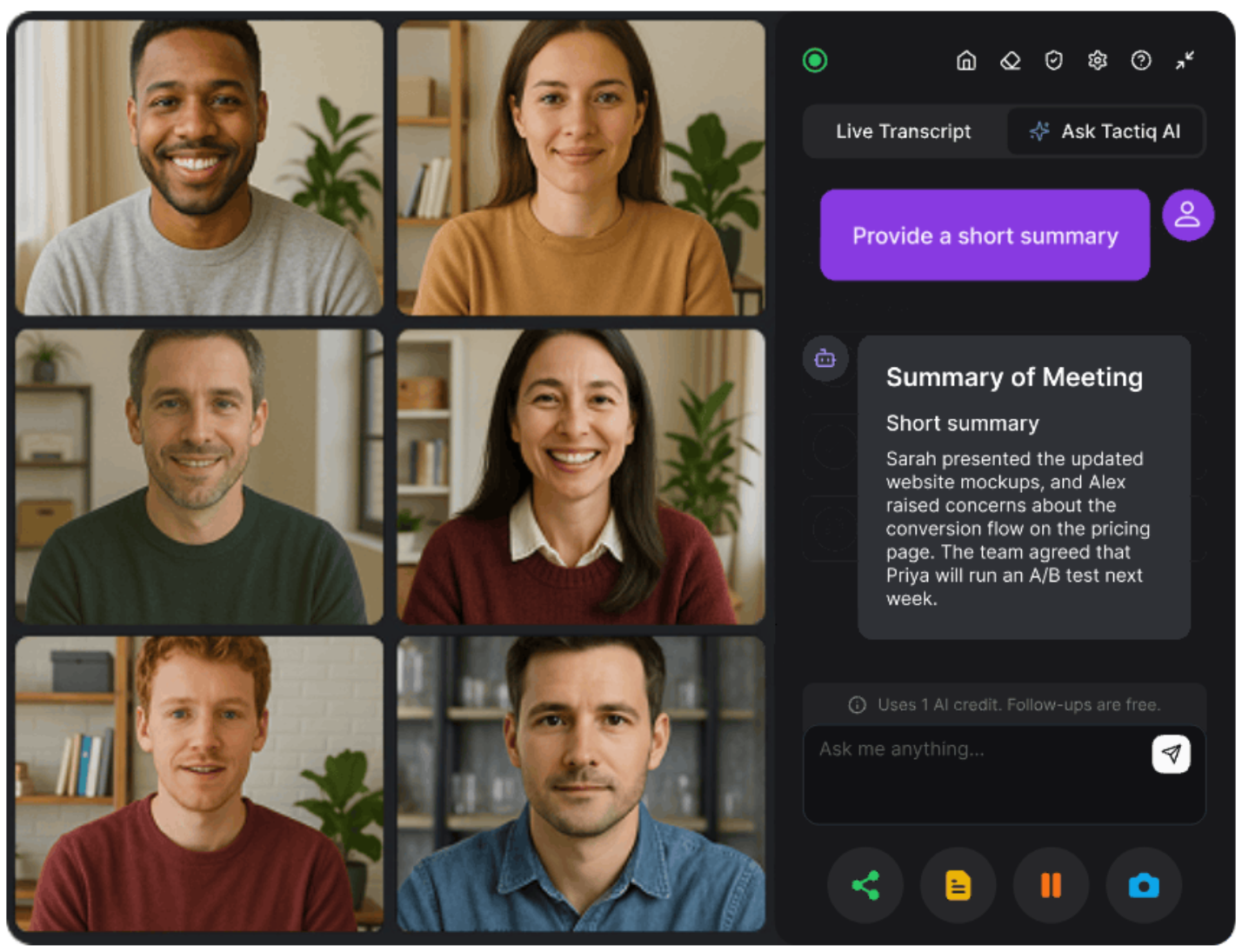
Tactiq goes beyond basic transcription. It supports structured interview review with tools designed for real hiring workflows.
Key capabilities include:
- Real-time speech-to-text transcription during interviews
- One-click AI summaries with key points and action items
- In-meeting AI that lets you ask questions about the conversation in real time
- Custom AI prompts for insights, feedback, and follow-ups
- Export options for Google Docs, Notion, and Slack
For job seekers
Job seekers can use transcripts to learn from every interview.
Tactiq helps you:
- Capture real interview questions and responses
- Review where answers lacked clarity or confidence
- Compare performance across job interviews
Many job seekers import transcripts into ChatGPT to refine answers and prepare for the next interview. Over time, this builds a personal knowledge base that supports career growth.
For recruiters and hiring managers
Recruiters benefit from having consistent, evidence-based interview records.
With Tactiq, teams can:
- Generate structured candidate feedback
- Share concise interview summaries internally
- Reduce bias by reviewing exact responses
Interview transcripts often feed into onboarding workflows, where ChatGPT can help structure materials for new employees.
Install the free Tactiq Chrome Extension today to capture interview transcripts, review real conversations, and turn every interview into a learning opportunity.
{{rt_cta_ai-convenience}}
Limitations And Best Practices With ChatGPT For Job Interviews
ChatGPT is a useful tool for interview preparation, but it works best when you understand its limits. Used correctly, it supports practice and reflection. Used blindly, it can create false confidence.
Where ChatGPT works well
ChatGPT shines when speed and structure matter.
It works best for:
- Practicing interview answers before an upcoming interview
- Improving resume writing and cover letter drafts
- Getting immediate feedback on clarity and structure
- Exploring job search strategies and career paths
For many job seekers, it acts like a career coach that is always available. It helps generate ideas, reframe answers, and improve communication abilities.
Where human review still matters
ChatGPT does not have judgment, lived experience, or full context. It can also hallucinate facts, especially about companies, roles, or industry trends.
Be careful when using it for:
- Company-specific details
- Claims about job openings or job market trends
- Assumptions about company culture or hiring managers
Always verify factual information and apply critical thinking before using suggestions in a real interview.
Best practices for better results
To get more value from ChatGPT during interview preparation:
- Treat outputs as drafts, not final answers
- Cross-check facts and examples
- Focus on improving structure, not memorization
- Combine practice with a review of real interviews
This is where pairing ChatGPT with interview transcripts becomes useful. Practice helps you prepare. Reviewing real conversations helps you improve.
Embracing AI Tools For Smarter Interview Preparation
AI tools now play a real role in career development. ChatGPT helps job seekers prepare for interviews by practicing answers, refining interview skills, and exploring career paths with structure and speed. New features like voice mode, memory, and record mode support deeper reflection over time.
Preparation alone is not enough. Real improvement comes from reviewing what actually happened. That’s why combining practice with accurate interview transcripts matters. Reviewing real questions, answers, and follow-ups leads to better decisions and measurable progress.
Used together, ChatGPT and transcript tools support continuous improvement across interviews. One helps you prepare. The other helps you learn from experience. That combination leads to stronger interviews, clearer feedback, and better outcomes over time.
FAQs on ChatGPT for Job Interviews
Is it good to use ChatGPT for interview preparation?
Yes, ChatGPT can be a valuable resource for interview preparation. It helps job seekers practice answers, improve interview skills, and structure responses. It works best when used as a support tool alongside critical thinking and real feedback.
Can ChatGPT help in interviews?
ChatGPT can help before and after interviews, but not during live interviews. It supports mock interview practice, resume writing, and follow-up email drafts. For real interviews, reviewing transcripts provides more accurate insights.
Can interviewers detect ChatGPT use?
Interviewers can sometimes detect overly generic or scripted answers. To avoid this, personalize responses, use real examples, and avoid memorizing AI-generated content word for word. Authentic answers matter more than perfect phrasing.
What is the best prompt for job interview practice in ChatGPT?
A strong prompt gives ChatGPT context and structure. For example:
“Act as a hiring manager for this role. Ask interview questions one at a time and provide feedback using the STAR method.”
Can I use ChatGPT for a job interview?
You should not rely on ChatGPT during a live job interview. Most employers expect independent responses. ChatGPT is best used for preparation, practice, and reflection before or after the interview process.
ChatGPT lets you practice mock interviews, generate common interview questions, and get feedback on your answers. This helps you build confidence and improve your communication skills, so you walk into interviews feeling ready and self-assured.
First, install the Tactiq Chrome extension and connect it to your video conferencing tool. During your interview, Tactiq transcribes the conversation in real time, and after the call, you can access the transcript and AI-generated summary to analyze your answers and identify areas for improvement.
You can use ChatGPT to learn new subjects, explore job search strategies, and get advice on industry best practices. This empowers you to expand your skillset and discover new opportunities, making your career growth more efficient and informed.
Tactiq provides accurate transcripts and AI summaries of your interviews, while ChatGPT helps you analyze your responses and refine your answers. By using both tools, you gain actionable insights and can continuously improve your interview performance for future opportunities.
AI tools offer valuable practice and feedback, but they may not capture every nuance or industry-specific detail. Consulting human mentors and experts ensures you get well-rounded guidance, so you make the best decisions for your career growth.
Related articles





Want the convenience of AI summaries?
Try Tactiq for your upcoming meeting.
Want the convenience of AI summaries?
Try Tactiq for your upcoming meeting.
Want the convenience of AI summaries?
Try Tactiq for your upcoming meeting.